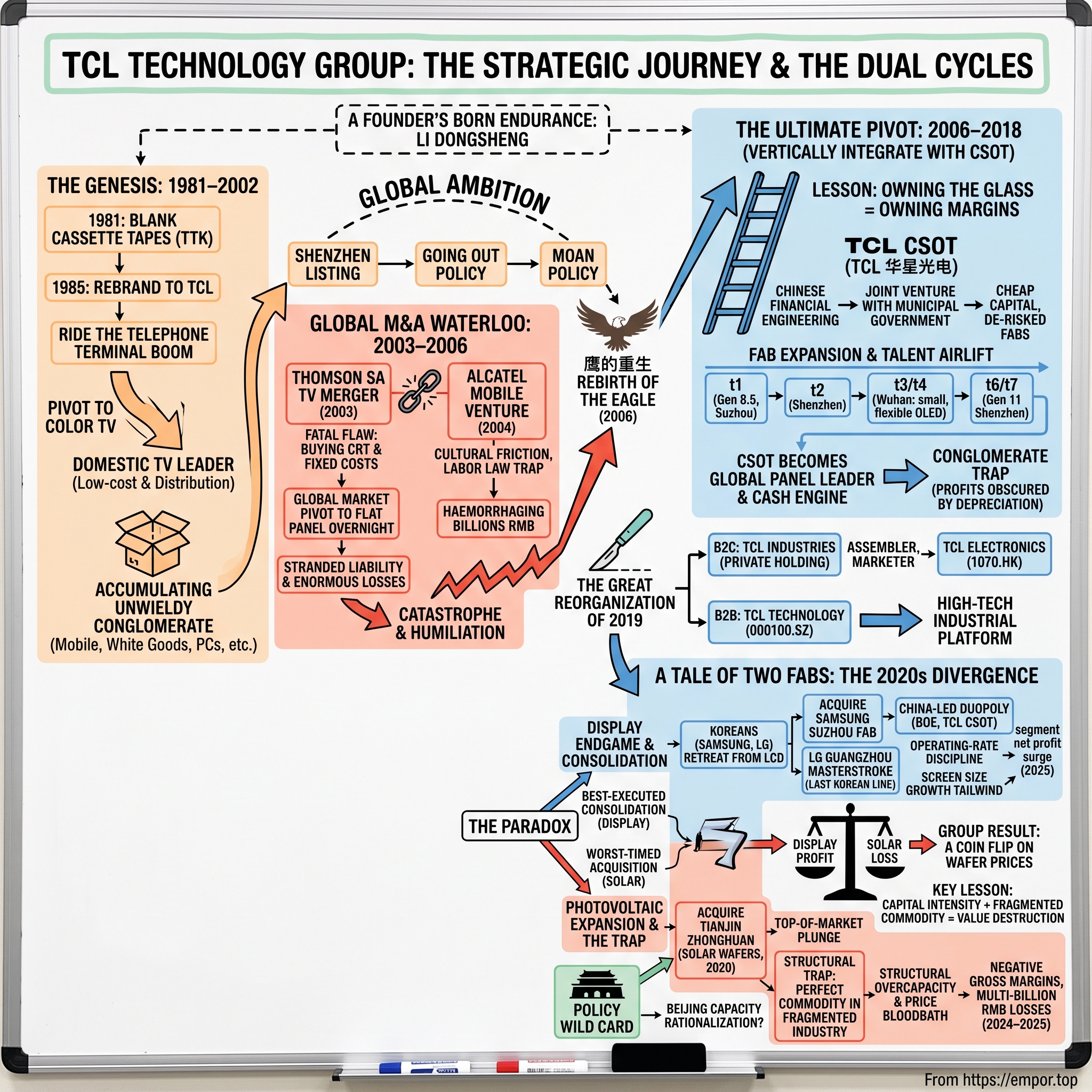
TCL Technology: The Panel Duopoly and the Solar Trap
Walk into a Costco in suburban America and you will find a wall of TCL televisions—65-inch, 75-inch, sometimes 85-inch slabs of glass priced hundreds of dollars below the Sony or Samsung sets beside them. To the Western shopper, TCL is a value brand, the sensible-shoes choice for a living-room upgrade. That impression is not wrong, exactly. It is just aimed at the wrong company.
The budget TVs at Costco are sold by a Hong Kong–listed consumer business. The company this story is about—TCL 科技集团股份有限公司 TCL Technology Group Corporation (000100.SZ), listed in Shenzhen—does not really want to sell you a television. It wants to own the single most expensive component inside it: the display panel. And on that quieter, more capital-intensive battlefield, TCL is not a value brand at all. It is one of two Chinese giants that together came to control the physical infrastructure of the world's flat screens, having patiently outlasted the Japanese, Taiwanese, and Korean champions who invented the industry.
Here is the paradox that makes TCL Technology one of the more fascinating industrial stories in China today. In its 2025 financial year the company earned a net profit of roughly RMB 4.52 billion on revenue of RMB 184.06 billion, nearly tripling the prior year's bottom line.1 Its display arm printed record profits. And yet for two years running, one half of the company had been quietly hemorrhaging billions of RMB into a Chinese solar-industry price war so brutal that wafer makers were, at the depth of it, selling product below the cash cost of making it. This is a company simultaneously running one of the best-executed manufacturing consolidations of the decade and one of the worst-timed commodity acquisitions—inside the same balance sheet, at the same time.
I. Introduction & The Strategic Split
To understand TCL Technology, you have to first accept that the name you think you know refers to something else. The 2019 restructuring that we will come to split the old sprawling conglomerate into two entities that share a brand and a founder but almost nothing else.
On one side sits TCL Technology (000100.SZ), the Shenzhen-listed parent that concerns us here. It is a business-to-business, high-tech manufacturing platform with two engines. The first is TCL 华星光电技术有限公司 TCL China Star Optoelectronics (TCL CSOT), its semiconductor-display arm, which fabricates the LCD and OLED panels that go into televisions, monitors, laptops, and phones the world over. The second is TCL 中环 TCL Zhonghuan (002129.SZ), a maker of monocrystalline silicon wafers—the foundational raw material of solar cells—and semiconductor-grade silicon. Both are asset-heavy, cyclical, capital-devouring industrial businesses. Neither sells anything with a TCL logo to a consumer.
On the other side sits TCL Industries, a privately held holding company, and its Hong Kong–listed affiliate TCL Electronics (1070.HK). This is the TCL the West knows: the assembler and marketer of televisions, air conditioners, and smartphones. It buys panels—often from CSOT—wraps them in plastic and electronics, and sells the finished box.
The distinction is not pedantic. It goes to the heart of how you value the thing. The consumer business is a brand-and-distribution game with thin margins and modest capital needs. The parent is an infrastructure business: it lives and dies on fab utilization, panel pricing cycles, government co-investment, and the ability to roll over enormous debt loads through downturns. Confuse the two and you will mis-price both.
So how did a company that started life making blank cassette tapes in a Guangdong backwater end up here—running a panel oligopoly with one hand while nursing multibillion-RMB solar losses with the other? The answer runs through four decades of near-death experiences and reinventions. The humble origins in Huizhou. The catastrophic French acquisitions of the early 2000s that nearly killed the company and produced its founder's legendary corporate manifesto, 鹰的重生 Rebirth of the Eagle. The audacious, arguably bet-the-company decision to build its own display fabs from scratch. The 2019 surgery that finally let the market see the display asset clearly. And the two divergent M&A campaigns of the 2020s: a disciplined, counter-cyclical consolidation of the global LCD industry on one hand, and a top-of-the-market plunge into solar on the other.
It is a story about a founder who has been running the same company for over forty years, who has been to the brink and back, and whose greatest strength—an almost geological patience with capital-intensive bets—is also the source of his most expensive mistake.
Myth versus reality
Before we go further, it is worth naming the three misconceptions that trip up almost everyone who encounters this company. The first is that TCL is a consumer-electronics business; it is not—the entity we are discussing sells almost nothing to consumers and lives on panel pricing and wafer pricing. The second is that TCL is a "green energy" stock, a label the market briefly slapped on it during the solar boom; in reality the solar business has, over the most recent two years, been the single largest destroyer of value on the group's income statement. The third and subtlest misconception is that the two halves are diversification in any useful sense. Real diversification means uncorrelated risks that smooth each other out. What TCL actually built was two ferociously capital-intensive, cyclical manufacturing businesses that can, and in 2024 did, turn cold in ways that compound rather than offset. Holding those three myths up against the facts is the fastest way to understand what you are actually looking at. So let us start at the beginning, in 1981, with the tapes.
 Subscribe on LinkedIn
II. The Genesis: Cassettes, Telephones, and the TV Boom (1981–2002)
In 1981, Huizhou was not a place the world watched. A modest city in Guangdong province, an hour or so inland from the emerging boomtown of Shenzhen, it was exactly the sort of place where China's economic reforms were being quietly tested. That year, a small joint venture began producing one of the least glamorous products imaginable: blank audio cassette tapes, under the brand TTK.4
There is a nice irony in the origin. The company that would one day fabricate the most advanced display glass in the world began by making a commodity so generic that its very name got it into legal trouble—the Japanese cassette giant TDK objected to the similarity, and in 1985 the company rebranded to the three initials it still carries: TCL.4 With the new name came a new product line. China in the mid-1980s was wiring itself up, and telephones were the growth market. TCL pivoted to manufacturing telephone terminals and rode the first great wave of Chinese telecommunications modernization, at one point becoming a leading domestic telephone brand.
The man who would come to embody the company joined in this era. 李东生 Li Dongsheng, a young engineer trained at South China University of Technology, was one of the founding cohort and would spend his entire career at the company, rising to run it and never leaving.5 His story and TCL's are, for all practical purposes, the same story—a rarity in corporate life and a fact that matters enormously when you assess how capital gets allocated here. You are not betting on an institution with a rotating cast of professional managers. You are betting on one man's judgment, formed over four decades of the same industry.
To appreciate why the telephone era mattered, remember what China looked like then. Telephone penetration was minuscule, the state was investing heavily in telecommunications infrastructure, and demand for handsets ran far ahead of supply. A domestic manufacturer that could produce reliable, affordable telephone terminals had a tailwind at its back that had nothing to do with brilliance and everything to do with being in the right country at the right decade. TCL learned, in this period, the lesson that would define its entire corporate life: in China, the winning move is often not to invent the product but to manufacture an existing product at scale, at low cost, and to distribute it further and cheaper than anyone else. That is a playbook for capturing a booming domestic market. It is not, as the company would later discover at enormous cost, a playbook for global technology leadership.
The defining pivot came in the early 1990s, when TCL moved into color television. This was the business that made the company. Rather than compete head-on with imported brands on technology, TCL competed on cost and on distribution. It built what amounted to a private army of salespeople and a direct-to-retail network that reached deep into China's smaller cities and towns—the lower-tier markets that foreign brands found expensive to serve.6 In an era when the fiercest domestic rivals were state-owned names like Changhong and the Panda brand, and Japanese sets carried a price premium, TCL's combination of low-cost manufacturing and ground-level distribution let it take real share in the fastest-growing television market on earth.6
But success in one product line bred a familiar disease. Flush with television cash, TCL began accumulating an ungainly collection of businesses: mobile phones, white goods, personal computers, electrical components, distribution. By the turn of the millennium it had become a classic Asian conglomerate—diversified, vertically and horizontally, into a structure that public markets would spend the next twenty years discounting. The logic of these sprawling groups is always the same and always seductive: shared brand, shared distribution, shared management talent, diversified cash flows. The problem, as TCL would learn painfully, is that a conglomerate's worst business tends to set its valuation, and its best business gets no credit.
There was also a specific event that turbo-charged Li's ambitions and his cash pile: TCL's own listing. The company went public on the Shenzhen exchange in the early 2000s, giving Li both a currency for acquisitions and a very public stage on which to prove that a Chinese firm could play in the global big leagues. National pride and personal ambition fused. This was the era when the phrase "going out"—Chinese companies venturing abroad to buy Western assets—was becoming state-encouraged policy, and Li Dongsheng wanted to be the poster child.
That conglomerate ambition was about to meet its most dangerous test. Li Dongsheng did not want to be merely China's leading television maker. He wanted TCL to be China's first genuine global multinational—a brand that competed not in Huizhou but in Paris and New York. The stage was set for the most expensive lesson of his career.
III. The Global M&A Waterloo: Thomson & Alcatel (2003–2006)
By 2003, Li Dongsheng had the swagger of a man who had won every fight he had picked at home. China's WTO accession was fresh, Chinese manufacturing was ascendant, and the idea that a Chinese company might buy a storied Western brand and run it was intoxicating and new. Li decided to do it twice, in the same eighteen months, in the same country.
The first deal was for televisions. In November 2003, TCL announced it would merge its TV operations with those of France's Thomson SA, the venerable electronics group that owned the iconic RCA brand in North America. The combined entity, TCL-Thomson Electronics (TTE), would be two-thirds owned by TCL and one-third by Thomson, and it would instantly become one of the largest television manufacturers on the planet by volume.7 The brands were carved up by geography: TCL in Asia and emerging markets, Thomson in Europe, RCA in North America.7 For a company that had been making telephones two decades earlier, it was a staggering leap onto the world stage.
The second deal was for phones. In April 2004, TCL formed a mobile-handset joint venture with the French telecom giant Alcatel, injecting €55 million in cash for a 55% stake, with Alcatel holding the remaining 45%.8 On paper, TCL now had two global businesses stamped with famous European names. In the celebratory logic of the moment, this was a Chinese champion arriving.
The buggy-whip problem
It was, instead, a masterclass in buying the past. The fatal flaw in the Thomson deal was not price or culture, though both would bite. It was technology. What TCL had acquired was a vast global manufacturing footprint for cathode-ray-tube televisions—the heavy glass picture tubes that had defined the living room for fifty years. Li's team believed they had three to five years to milk that installed base for cash before the technology matured. Instead, the global market pivoted to flat-panel liquid-crystal-display televisions almost overnight. TCL had bought a world-class fleet of buggy-whip factories the same season the Model T rolled off the line. The CRT assets were not a cash cow to be milked; they were a stranded liability to be escaped.
The bleeding was severe and structural. TTE lost money at a pace that alarmed even a founder with high tolerance for pain, and the Alcatel venture fared no better as TCL struggled to integrate a European handset operation into a Chinese cost structure. Cultural friction between Chinese managers and a unionized French workforce paralyzed decision-making, and here the second trap sprang shut: under French and European labor law, restructuring or laying off workers was so slow and so expensive that the very act of stemming the losses became prohibitively costly. Over roughly eighteen months, the overseas businesses ran up losses on the order of RMB 1.8 billion, and TCL—which had entered these deals as a domestic champion—found itself staring at the possibility of failure.5
The deeper lesson, and the one that separates a survivable mistake from a fatal one, was about the difference between the two kinds of error TCL made. Overpaying for an asset is recoverable; you write it down and move on. But TCL had made a compounding error—it had bought a large, fixed, hard-to-exit cost base in a jurisdiction that made exit almost impossible, in a technology that was going to zero. That combination is what turns a bad deal into an existential one. It is a pattern worth filing away, because a version of it—buying a large, capital-heavy, hard-to-exit position in a business whose economics then collapsed—would recur in TCL's story two decades later, in solar.
Rebirth of the Eagle
Out of that humiliation came the piece of corporate mythology that still defines Li Dongsheng in Chinese business schools. In 2006, at the low point, he wrote and circulated an internal essay titled 鹰的重生 Rebirth of the Eagle. It drew on a (biologically dubious but rhetorically potent) parable: the eagle, reaching middle age, must retreat to a mountaintop and endure an agonizing self-renewal—smashing off its own overgrown beak against the rock, plucking out its worn talons and feathers—so that new ones can grow and it can live another thirty years.5 The message to a demoralized workforce was that survival required self-inflicted pain, the deliberate destruction of what no longer worked. It is easy to be cynical about founder manifestos, and the essay's fame can obscure how close the company came to genuine disaster. But the more important point for an investor is behavioral: faced with a catastrophic mistake of his own making, Li did not deny it, did not flee, and did not get fired. He restructured, absorbed the losses, and by 2007 the company had clawed its way back to profit.5
The near-death experience taught Li a lesson he would spend the next decade acting on—one far more consequential than any morale essay. He had learned, at ruinous cost, that you cannot win in flat-panel television by assembling other people's glass into plastic boxes. The value, and the danger, lived upstream in the panel itself. If TCL wanted to survive the next technology cycle, it would have to stop being a customer of the display industry and become the display industry.
IV. The Ultimate Pivot: Vertically Integrating with CSOT (2006–2018)
Consider what a flat-panel television actually is. Strip away the brand, the remote, the software, the speakers, and what you are left with is dominated by one component: the display panel, the sheet of precisely engineered glass and thin-film transistors that produces the image. In a modern TV, that panel represents something like 60 to 70 percent of the entire bill of materials. Everything else—the assembly, the bezel, the marketing—fights over the thin remainder. TCL's Thomson disaster had taught Li Dongsheng this arithmetic in the most expensive possible way. If you do not own the glass, you do not own your own margins, and you are perpetually hostage to the handful of Korean, Japanese, and Taiwanese firms who do.
A short detour on how display glass gets made
It is worth pausing to explain, in plain terms, what "owning the glass" actually involves, because the economics flow directly from the physics. A display panel is manufactured on a large sheet of glass called a mother substrate. A machine deposits and etches millions of microscopic transistors onto that sheet, which is then cut into individual panels. The "generation" of a fab—Gen 6, Gen 8.5, Gen 10.5, Gen 11—refers to the size of that mother substrate. A higher generation means a bigger sheet, and a bigger sheet can be cut into more panels, or into fewer very large panels, with far less wasted glass around the edges. A Gen 10.5 sheet is roughly the size of a garage door, and it is optimized to be sliced efficiently into exactly the 65-inch and 75-inch televisions the market increasingly wants. This is why generation matters so much: the right-sized fab for the popular screen size is dramatically cheaper per panel than the wrong-sized one, and building the wrong generation is a multibillion-dollar mistake you cannot easily undo.
The reason this business is so treacherous is the combination of scale and yield. A fab costs billions to build and runs best when it runs flat-out, because the depreciation and fixed costs are enormous whether the lines are busy or idle. And when a new fab starts up, a large fraction of the panels it produces are defective—the "yield" is low—until engineers grind the process into shape. A latecomer who takes too long to climb that yield curve simply burns cash until it dies. This is the wall TCL had to scale, and it explains why the industry had, for decades, been the exclusive preserve of a few deep-pocketed Japanese, Korean, and Taiwanese incumbents. Breaking in required money most companies could not raise and manufacturing discipline most could not muster.
So TCL decided to build the glass itself. This was not a modest capacity addition; it was one of the most audacious industrial bets a Chinese private company had ever attempted. Display fabrication is among the most capital-intensive activities in all of manufacturing, rivaling semiconductors. A single advanced fab costs billions of dollars, takes years to bring to yield, and can bankrupt an operator who stumbles on the learning curve. TCL, still recovering from the French wounds, had nothing like the balance sheet to fund such a thing alone.
The solution was a distinctly Chinese piece of financial engineering, and understanding it is essential to understanding this company. In November 2009, TCL announced it would form a joint venture with the Shenzhen municipal government to build an 8.5-generation TFT-LCD fab—the line that would become known as t1—at a cost of around US$3.9 billion.4 This was the founding of TCL CSOT. The genius of the structure was in who paid. The local government, hungry for a marquee high-tech employer and the tax base and prestige that came with it, supplied subsidized land, tax holidays, utility support, and—critically—direct equity co-investment alongside TCL. The state carried a large share of the upfront capital risk. Once the fab was operational and generating cash, TCL could buy out the government's stake at pre-agreed, non-punitive terms. It was capitalism with state characteristics: the public sector de-risked the plant's construction; the private operator captured the upside once it worked.
There is a subtlety in the buyout mechanism that rewards a close look, because it is where the risk hides. The arrangement works cleanly only if the fab actually becomes cash-flow positive on schedule, allowing TCL to repurchase the government's stake at the agreed terms. When a fab performs, everyone wins and the structure looks like genius. When a fab underperforms, or a cycle turns before the buyout, the obligations do not simply vanish—they sit on the balance sheet as commitments and as that large minority-interest line, and the relationship with the government partner becomes more complicated than a simple subsidy. The model has, for CSOT, mostly worked. But it is not free money; it is a sophisticated risk-sharing structure whose benign appearance depends on continued execution. An investor should read the "cheap capital" advantage as real but conditional on the fabs continuing to deliver.
This template—repeated in Shenzhen, Wuhan, and later Guangzhou—became the deepest structural advantage TCL possesses, and one no Western, Japanese, or Korean rival can replicate. It is the reason the company's balance sheet today carries tens of billions of RMB in "minority interest": those are the government co-investors, still riding alongside in the fabs. It is a genuine, durable edge. It is also, viewed from a distance, a form of subsidy that has helped flood the world with Chinese display capacity and crush the returns of everyone who financed their fabs on purely commercial terms.
Capital was necessary but not sufficient. TCL also had to actually run the thing, and here it did something few observers expected: it brought t1 to full capacity and competitive yields in remarkably short order. It short-circuited the brutal learning curve the way a latecomer always must—by importing the learning. TCL recruited hundreds of experienced display engineers from Taiwan and South Korea, a "talent airlift" that transplanted decades of hard-won process knowledge into a brand-new Chinese fab.4 What might have taken a decade of costly mistakes to learn organically was purchased, hired, and installed.
The cyclical engine takes shape
From that first fab, CSOT expanded with metronomic discipline across the 2010s. It added a second large-size LCD line in Shenzhen (t2), moved into small and medium LTPS-LCD panels for phones and tablets in Wuhan (t3), pushed into flexible AMOLED—the bendable organic-LED screens used in premium smartphones—also in Wuhan (t4), and built out enormous Gen-11 (G10.5-class) fabs in Shenzhen for the largest television panels (t6 and t7).
Each of these lines served a different slice of the market, and the alphabet soup of fab names hides a deliberate strategy. The large-size LCD lines (t1, t2, t6, t7) chased the television and monitor market, where China's cost advantage was most decisive and where sheer scale wins. The LTPS and flexible-OLED lines in Wuhan (t3, t4) were a beachhead into higher-value small and medium panels—the screens inside premium smartphones—where the Koreans, especially Samsung Display, had a commanding lead and fat margins. This second front is strategically important and easy to overlook: it is TCL's insurance against the day when television-sized LCD stops being the center of gravity. So far it remains the junior partner to the large-panel business, and CSOT is a follower rather than a leader in the highest-end mobile OLED, but the optionality is real. Each fab followed the same government-partnered playbook, and together they turned CSOT into a genuine cash engine and one of the two or three largest panel makers in the world. But every expansion also demanded fresh billions of capital and layered on more depreciation, and that mounting depreciation had a nasty way of swamping the reported profits of the rest of the group. CSOT was becoming a crown jewel trapped inside a structure that made it impossible for outsiders to see. The market could not tell whether it was looking at a great fab operator or a struggling appliance conglomerate, because on the income statement they were the same company. Something would have to give.
V. The Great Reorganization of 2019: Splitting B2B from B2C
Imagine you are an analyst trying to value TCL Corporation in 2018. You pull up the consolidated financials and immediately hit a wall. In a quarter when CSOT's panels were selling well, the low-margin television-assembly and mobile-phone businesses dragged the blended margin down. In a quarter when the consumer businesses hummed, CSOT's colossal, multibillion-RMB depreciation charges—the accounting cost of all those fabs—torched the consolidated profit. The two halves of the company were counter-cyclical in the worst way, each obscuring the other. Whatever multiple you assigned, you were wrong about half the business.
This is the conglomerate trap in its purest form, and public markets punished it with the reliability of gravity. A capital-intensive infrastructure asset like CSOT wants to be valued on its through-cycle earnings power, its capacity position, and its balance sheet. A consumer-electronics distributor wants to be valued on brand, volume, and working capital. Bolt them together and you get the worst of both: the market applies the low, skeptical multiple of the weaker business to the whole, and the crown jewel gets no credit for being a crown jewel. Sophisticated investors call this the conglomerate discount. For TCL it was less a discount than a permanent ceiling.
In 2019, Li Dongsheng did the surgery. TCL Corporation carved out its entire consumer-electronics, home-appliance, and mobile-terminal operations—the TVs, the air conditioners, the Alcatel and BlackBerry-branded phones—and sold them to a separately held private vehicle, TCL Industries (Holdings).3 The reported consideration for the package was around RMB 4.76 billion, a figure and a structure contentious enough that the Shenzhen Stock Exchange sent the company a lengthy list of pointed questions about related-party pricing—a reminder that these intra-group reshufflings deserve a skeptical read, since the founder sat on both sides of the table. The listed shell that remained was renamed TCL Technology Group Corporation.3
What was left standing was, for the first time, legible. TCL Technology became a pure-play high-tech industrial platform, and the market could finally look at CSOT for what it was—a piece of global display infrastructure—rather than as a line item buried inside an appliance distributor.3 The reorganization did not change a single fab or a single engineer. It changed only how the assets were packaged and disclosed. But that repackaging was the precondition for everything that followed, because it turned CSOT from an accounting complication into a fundable, valuable, standalone growth platform—one that could now go on the offensive.
It is worth dwelling for a moment on what the reorganization did not do, because the market's initial enthusiasm needs a skeptic's footnote. The split did not deleverage the company, did not reduce its capital intensity, and did not remove the founder from either side of the transaction—the consumer assets went to a vehicle he was closely associated with, at a price the exchange itself questioned. What it changed was legibility, not fundamentals. A cynic could fairly argue that the 2019 surgery was as much about creating a clean, financeable listed entity that could raise capital for the next round of fab-building as it was about "unlocking value" for public shareholders. Both readings are true at once, and holding them together is the right posture: the split was genuinely good for how CSOT could be valued and funded, and it was also an intra-group reshuffle whose terms deserved the scrutiny they received.
And offense was suddenly available, because at almost exactly this moment, the global display industry was breaking in TCL's favor. The Koreans were about to retreat.
VI. The Display Endgame & The LG Guangzhou Masterstroke (2020–2025)
Picture the boardroom at LG Display or Samsung Display around 2019 and 2020. These were proud companies that had spent tens of billions of dollars and two decades building the world's most advanced LCD lines, and they were staring at spreadsheets that no longer worked. Every incremental panel they sold earned less than the one before, because a wall of Chinese capacity had made the product a commodity and the price a race to the bottom. The rational conclusion was almost unthinkable for engineers who had defined the category: get out. Concede the commodity to the Chinese, take the write-downs, and retreat to the high-margin frontier of OLED, where a technology lead still bought some breathing room. That decision—made in Seoul, out of hard necessity—was the gift that made TCL's endgame possible.
For most of the flat-panel era, the LCD business had a familiar hierarchy. The technology had been commercialized by the Japanese, scaled by the Koreans—Samsung Display and LG Display—and cost-optimized by the Taiwanese. Chinese firms were the upstarts, buying equipment and hiring talent to catch up. By the late 2010s, they had not just caught up; they had changed the physics of the industry.
The mechanism was capacity. Led by 京东方 BOE Technology and TCL CSOT, Chinese panel makers—financed by the government-partnered model described earlier—poured wave after wave of new Gen-8.5 and Gen-10.5 capacity into the market. LCD panel prices, which had always been cyclical, entered a structural decline. For Samsung Display and LG Display, the math curdled. They could no longer earn an acceptable return manufacturing commodity LCD television panels against rivals whose fabs had been partly de-risked by municipal governments and who were willing to run flat-out through downturns. The Korean giants made a strategic decision: abandon commodity LCD entirely and retreat upmarket into high-end OLED, where they still held a technology lead.
Their exit was TCL's opportunity, and CSOT played it with a discipline that stands in sharp contrast to the reckless expansion that had crushed prices in the first place. Rather than build yet more greenfield capacity into an oversupplied market, TCL bought the incumbents' plants as they fled. In 2020, CSOT acquired a stake in Samsung's Gen-8.5 LCD plant in Suzhou—the fab that became known as t10. TCL and its partners paid about US$1.08 billion for a 60% interest in the Suzhou operation, with TCL taking a direct slice and the Suzhou municipal government co-investing in the now-familiar pattern.10 The elegant twist was that Samsung Display did not simply cash out and walk away. It reinvested a portion of the proceeds—reported at around US$739 million—to take a roughly 12.33% minority stake in CSOT itself, aligning the departing Korean champion with the ascendant Chinese one and locking in a long-term panel-supply relationship.10 The seller became a shareholder in the buyer. It was consolidation dressed as partnership.
The masterstroke, though, came at the bottom of the next cycle. By 2024, LG Display had one LCD television-panel fab left: an 8.5-generation line and a co-located module plant in Guangzhou. LGD, deep in its own OLED transition and carrying heavy debt, wanted out. In September 2024, at what looked like a cyclical trough for LCD, TCL CSOT was named the winning bidder to acquire 80% of the Guangzhou 8.5-generation panel line and 100% of the module factory for RMB 10.8 billion, roughly US$1.5 billion.11 The transaction closed in April 2025, and with it LG Display exited LCD television-panel manufacturing altogether—the last of the great Korean LCD lines passing into Chinese hands.12
The strategic logic of buying assets at the bottom, from a distressed seller, while competitors were paralyzed, is exactly the counter-cyclical discipline that separates good capital allocation from bad. But its real significance is structural. With both Samsung and LG fully out of commodity LCD television panels, the industry collapsed into an effective Chinese-led oligopoly. China's share of global LCD production reached roughly 72%, and Chinese firms—BOE, TCL CSOT, and HKC—came to account for something like 70 to 85 percent of the panels in the largest, most valuable television sizes.13 BOE and TCL CSOT sat at the top of that heap as the two dominant players in large-size panels.
The rival that makes the duopoly work: BOE
You cannot understand CSOT without understanding 京东方 BOE Technology, its larger Chinese rival and the other half of the duopoly. BOE, based in Beijing and also nurtured on government-partnered capital, is the world's largest display maker by area, and for years it was CSOT's most aggressive competitor in the race to add capacity—part of the very dynamic that crushed prices and drove the Koreans out. The two are not friends. But a duopoly does not require friendship; it requires only that each player recognizes its own interest in not blowing up the price. Once BOE and CSOT together controlled the majority of large-size supply, the calculus shifted. Adding reckless new capacity to grab a few points of share now mostly hurts yourself, because you are a large enough share of the market that your own oversupply drags down the prices on all your other panels. That self-interested restraint—not any formal agreement—is what "operating-rate discipline" really means, and it is why a market of two behaves so differently from a market of ten.
Why does concentration matter so much here? Because it changes the game from a war of all against all into something closer to a managed equilibrium. When a dozen fabs owned by rivals in five countries are all fighting for share, the rational move for each is to run flat-out even into a glut—the classic prisoners' dilemma that had crushed prices and driven the Koreans out. But when two disciplined Chinese players dominate supply, a different logic becomes possible: what the industry calls "production control according to demand," or operating-rate discipline. Instead of blindly maxing out, the leaders throttle utilization to match demand, smoothing the vicious price swings that had defined the LCD business for two decades.
The evidence that this discipline is real, and not just a hopeful narrative, showed up in the numbers. In 2024, CSOT's display business generated revenue of RMB 104.25 billion at a gross margin of 19.15%—a genuinely healthy figure for what used to be a commodity business—and a segment net profit of RMB 6.23 billion.2 In 2025, CSOT pushed further, with revenue of RMB 105.24 billion, up 17.4%, and net profit surging 44.4% to RMB 8.01 billion.1 For a business whose defining characteristic used to be that it lost money every time the cycle turned, earning double-digit margins and rising profits through a period of soft consumer electronics demand is the single strongest piece of evidence that the industry's structure has actually changed. A skeptic should still ask how durable operating-rate discipline is—cartels of two are more stable than cartels of ten, but they are not permanent, and a demand shock or a capacity land-grab by a third player could crack it. But for now, the display half of TCL is doing exactly what the vertical-integration bet was supposed to make it do fifteen years ago: printing money.
There is a second tailwind beneath the pricing discipline, and it is worth spelling out because it is one of the more durable parts of the bull case. Television screens keep getting bigger. The average television sold globally has been marching upward in size for years, from the low-40-inch range toward 55, 65, and beyond. This matters enormously to a panel maker because glass area scales with the square of the diagonal: a 75-inch panel does not consume a bit more glass than a 55-inch one, it consumes roughly twice as much. Every inch of average-size growth soaks up disproportionate fab capacity, which means that even flat unit demand for televisions translates into rising demand for panel area. For an industry that lives or dies on capacity utilization, a structural trend toward bigger screens is a slow, steady, demand-side gift—and it is the single most important reason CSOT's Gen-10.5 fabs, optimized for exactly those large sizes, are strategically well-placed rather than at risk of obsolescence.
Which makes what was happening in the other half of the company all the more painful.
VII. The Photovoltaic Expansion & The Overcapacity Trap (2020–2026)
Rewind to 2020. CSOT was throwing off cash, the display cycle was turning up, and Li Dongsheng had a problem that most executives would envy: what to do with the money. Display is ferociously cyclical, and a prudent operator wants a second engine to smooth the ride. TCL went looking for another high-tech, asset-heavy, growth business where its core competencies—running enormous capital-intensive plants, partnering with governments, importing engineering talent, grinding down the cost curve—might transfer. It found solar.
In June 2020, TCL Technology announced it would invest about RMB 11 billion, roughly US$1.6 billion, to acquire Tianjin Zhonghuan—a state-owned enterprise whose crown jewel was a listed subsidiary that ranked among the global leaders in monocrystalline silicon wafers, the pure silicon substrate from which solar cells are cut, along with a semiconductor-materials business.9 TCL won the auction in July 2020 and closed the deal at the end of that year.9 The renamed TCL Zhonghuan gave the group a second industrial pillar, and on the surface the strategic fit was obvious: silicon wafers, like display panels, are a scale-and-yield game where the low-cost producer wins.
What a solar wafer actually is, and why it is a trap
A word on the product, because the nature of the trap is embedded in it. A solar panel begins as ultra-pure polysilicon, which is melted and grown into a large cylindrical crystal called an ingot, then sliced into wafers thinner than a sheet of paper. Those wafers are processed into cells, and the cells are assembled into modules—the blue rectangles on rooftops. TCL Zhonghuan sat at the wafer step, and it was genuinely world-class at it: monocrystalline wafers reward precisely the skills TCL already had, namely running huge crystal-growing and slicing operations at high yield and low cost. On paper it was the perfect adjacency.
The fatal difference from display is structural, not operational. A display panel is a complex, differentiated component sold to a concentrated set of large customers, in an industry that consolidated to a handful of players. A solar wafer is a near-perfect commodity—one producer's wafer is essentially interchangeable with another's—sold into a fragmented industry where dozens of well-financed players can and did build capacity. In display, being the low-cost producer at scale earns you pricing power. In wafers, being the low-cost producer at scale earns you the right to survive a little longer than the next company while everyone loses money together. TCL applied the right operational playbook to an industry with the wrong structure, and that mismatch—not any failure of execution—is the root of what came next.
For the first two years, it looked like one of the great acquisitions of the era. Global solar demand exploded between 2020 and 2022, supercharged by decarbonization policy and energy-security fears. Silicon wafer prices soared, TCL Zhonghuan generated record profits, and TCL Technology's shares were re-rated as a green-energy champion. The group's 2021 net profit swelled to roughly RMB 10 billion—its best year in memory—as both engines fired at once.2 Li Dongsheng had, it seemed, timed the solar boom perfectly. He had bought a commodity producer at the beginning of a super-cycle.
The scale of the swing is worth internalizing, because it is the clearest illustration of what "commodity cyclicality" really means for a balance sheet. In its best recent year the group as a whole earned around RMB 10 billion, with solar and display both contributing.2 Within three years, the same solar business that had helped drive that record had flipped to losing nearly RMB 10 billion by itself.2 A single segment moved roughly RMB 20 billion between a good year and a bad one—swamping the steadier contribution of the display business and turning the consolidated result into a coin-flip on wafer prices. This is the defining feature of the asset that TCL bought: not that it is badly run, but that its earnings are almost entirely hostage to a commodity price the company cannot control. When you buy a business like that, you are not buying a hedge against display cyclicality; you are buying a second, uncorrelated source of the exact same cyclical risk. The "diversification" logic that justified the acquisition was, in this sense, an illusion from the start.
Or, as it turned out, near the top of one. The problem with commodity manufacturing is that the same boom that rewards you also invites everyone else to build. And build they did. Across China, wafer, cell, and module makers—TCL Zhonghuan among them, alongside giants like 隆基绿能 LONGi Green Energy and 通威股份 Tongwei—raced to add capacity into the super-cycle, each rationally, each simultaneously, until the aggregate result was monumental, structural overcapacity. Chinese solar manufacturing capacity came to exceed global demand by a wide margin. And in a commodity with low switching costs and undifferentiated product, overcapacity does not produce a gentle price decline. It produces a bloodbath.
Through 2024, solar-grade silicon and wafer prices collapsed, at the worst point falling below the cash cost of production—the point at which every unit sold deepens the loss, yet idling the plant is often even more expensive because of fixed costs and the ruinous economics of restarting a fab. This is the prisoners' dilemma at its most vicious: no single producer can stop without ceding ground, so they all keep bleeding together. The financial devastation at TCL Zhonghuan was severe and it was fast. In 2024, the segment's revenue plunged 51.95% year-over-year to RMB 28.42 billion, its gross margin cratered to negative 9.08%—it cost more to make the wafers than they sold for—and it recorded a net loss of RMB 9.82 billion.2 A business that had earned record profits two years earlier was now one of the largest loss-makers in TCL's history.
The pain did not stop with the calendar. Management guided to a further net loss of roughly RMB 8.2 to 9.6 billion for 2025, and the year came in near the bottom of that range, with a loss of around RMB 9.2 billion even as revenue stabilized modestly.1415 Two consecutive years of nine-figure-plus losses in a business acquired for RMB 11 billion is, by any honest accounting, a capital-allocation failure—not of strategy in the abstract, but of timing and of failing to foresee the overcapacity wave that China's own industrial incentives made almost inevitable.
Here is where the two halves of TCL collide, and where the conglomerate ghost that the 2019 split was supposed to exorcise comes creeping back. In 2024, the display business printed RMB 6.23 billion of profit and the solar business lost RMB 9.82 billion, and the group's consolidated net profit attributable to shareholders was dragged all the way down to just RMB 1.56 billion.216 The stellar turnaround in panels was almost entirely cancelled out by the disaster in wafers. TCL had spent the 2010s escaping the trap of one great business being obscured by a weak one—and then, through the Zhonghuan acquisition, rebuilt a version of the same trap with its own hands. The market is once again looking at a company where the crown jewel's performance is masked, this time not by an appliance distributor but by a solar cash-drain.
The policy wild card: can Beijing stop the bleeding?
The one lever that could change everything sits not with any company but with the Chinese state. The solar price war is a textbook case of what Chinese commentators have taken to calling 内卷 involution—a self-defeating, all-against-all competition in which everyone works harder and invests more only to make everyone collectively worse off. Solar overcapacity has become severe enough, and politically visible enough, that Beijing has begun signaling impatience, floating the idea of curbing the reckless capacity additions and price-cutting that have turned a strategic national industry into a money pit. If the state were to enforce genuine capacity rationalization—pushing the weakest players out and disciplining the rest—wafer prices could recover to something above cash cost, and a survivor like TCL Zhonghuan, with a strong balance-sheet parent behind it, would be among the beneficiaries. But this is a hope resting on policy that has not yet arrived in force, and China's track record of actually shrinking politically favored industries is mixed at best. An investor should treat the "Beijing rides to the rescue" thesis as optionality, not as a plan.
The one genuinely encouraging sign, as of mid-2026, is that the drag appears to be narrowing rather than widening. The 2025 group result—net profit of RMB 4.52 billion, up nearly 189%—came despite Zhonghuan's continued losses, because CSOT's profits grew fast enough to more than absorb them.1 Whether that marks the bottom of the solar winter or merely a pause depends on questions no one in the industry can yet answer: whether prices have found a floor, and whether Beijing will intervene to force the capacity rationalization that market competition alone has been unable to achieve.
VIII. Management Profile, Governance, & Incentives
Every company has a culture, but few have a founder so completely fused with the institution that the two cannot be discussed separately. Li Dongsheng has been at TCL since its cassette-tape infancy and has run it, in one capacity or another, for the entire arc of its transformation—through the color-TV wars, the French near-death, the CSOT gamble, the reorganization, and the solar boom and bust.5 To assess TCL's governance is, first and foremost, to assess him.
Start with incentives, because they are unusually well-aligned in one respect and structurally unusual in another. Li Dongsheng is a large direct owner of the company he runs—holding on the order of 898 million shares of TCL Technology outright, and, together with a concert party centered on the Ningbo Jiutian Liancheng investment partnership, controlling roughly 1.26 billion shares, which makes his group the single largest shareholder bloc.[^17] On the enlarged share count of nearly 19 billion shares, that direct stake works out to only about 5%, and the concerted group to something under 7%—a figure worth date-stamping, since older filings that predate years of share issuance cited a higher percentage against a smaller base. The dilution itself tells a story: funding a fleet of multibillion-dollar fabs has repeatedly meant issuing equity, steadily shrinking the founder's percentage even as his absolute holding stayed large.
The governance headline that follows from this is that TCL Technology reports no controlling shareholder and no actual controller—no single entity holds anything close to a majority.[^17] This is a genuine double-edged sword. On one hand, it lets Li share the enormous capital-raising burden of the display and solar businesses with state and private co-investors, and it insulates the company from the perception of being any one person's fiefdom. On the other, it concentrates enormous de facto operational control in a founder who owns a relatively modest slice of the equity—a classic separation of control from cash-flow rights that governance-minded investors watch carefully, because it can enable empire-building on other people's money. The 2019 sale of the consumer assets to a founder-linked private vehicle, and the exchange's pointed questions about it, is exactly the kind of related-party dynamic that this structure invites and that deserves ongoing scrutiny.
The capital-allocation scorecard
On capital allocation, the record is genuinely mixed, and it is more useful to say so plainly than to grade on a curve. The good is very good. The creation of CSOT in 2009 was a visionary, contrarian bet that a nearly bankrupt television assembler could become a world-class panel maker—and it worked. The counter-cyclical acquisitions of the Samsung Suzhou and LG Guangzhou fabs were textbook examples of buying distressed assets at the bottom while rivals were frozen, consolidating an industry into a favorable structure. The bad is also very bad. The Tianjin Zhonghuan acquisition, executed with cash from the display business, bought a commodity producer near the peak of a super-cycle and then absorbed two straight years of multibillion-RMB losses as the predictable overcapacity wave broke. Both the triumph and the failure share a common root: a founder with extraordinary conviction and patience for capital-intensive, cyclical bets. That temperament is precisely what let him build CSOT when the world thought it was folly—and precisely what led him to double down on another asset-heavy commodity at exactly the wrong moment.
There is one more governance dimension a careful investor should weigh: the depth of the bench and the succession question. Li Dongsheng has been at the helm for the entire life of the company, and while that continuity has been an asset through crises, it also concentrates institutional memory and strategic judgment in a single person who will not run the company forever. TCL has professional managers running CSOT and Zhonghuan, and the display leadership in particular has executed the consolidation impressively. But the founder's fusion with the institution means that the eventual transition—whenever it comes—is a genuine, if not imminent, risk that does not show up on any balance sheet. A company this dependent on one man's relationships with banks and municipal governments has to prove that those relationships are institutional and not merely personal.
Credibility, earned the hard way
What can be said for Li's credibility is that it is anchored in behavior over a very long horizon. He has been through a genuine near-death experience and did not flinch, hide, or blame others; the Rebirth of the Eagle episode, mythologized as it is, describes a man who owned a disaster and worked through it.5 That track record of survival is what has given TCL durable access to low-cost capital from Chinese banks and municipal governments even in deep downturns—an intangible but real asset. The open question, which the solar losses sharpen, is whether the same conviction that makes him a great builder also makes him slow to cut a losing bet. An investor watching this management team should be listening, on each results cycle, for whether the plan for Zhonghuan is concrete and time-bound or merely a promise that the cycle will turn.
IX. Playbook: Business & Investing Lessons
Step back from the narrative and TCL Technology resolves into two businesses with almost opposite competitive structures—which is what makes it such a useful teaching case. Run each through the standard strategy frameworks and the divergence is stark.
Take Hamilton Helmer's 7 Powers and apply them to TCL CSOT, the display business. The dominant power is scale economies, and in panels this is not an abstraction—it is the whole game. Display fabrication has enormous fixed costs and punishing operating leverage. The difference between running a Gen-10.5 fab at 95% utilization and at 80% can be the difference between a fat margin and a cash loss, because the fixed depreciation and overhead don't shrink when the lines slow down. A player with the largest, most modern capacity block, run at high utilization, has a structural cost advantage that a smaller rival simply cannot match, and that advantage compounds—more scale funds more R&D and the next fab, which builds more scale. The second, and in TCL's case arguably deeper, power is a cornered resource: the systemic partnerships with Chinese municipal governments in Shenzhen, Wuhan, Guangzhou, and Suzhou. Subsidized land, tax holidays, utility rebates, and direct equity co-investment amount to a reservoir of low-cost capital that Western, Japanese, and Korean competitors cannot access at all—it is the single clearest reason the Koreans retreated and the Chinese advanced. There is also a layer of process power in accumulated yield-optimization and fab-automation know-how, though this is the most replicable of the three and the one talent can flow across borders to erode.
A fair critique of the 7 Powers read on CSOT is that two of the three powers are borrowed rather than owned. The cornered resource is government largesse, which is a policy choice that can be withdrawn, redirected to a favored rival, or complicated by geopolitics—the display industry sits squarely inside the US-China technology contest, and export controls or foreign-market restrictions could yet reshape it. And the scale advantage, while real, is shared with BOE rather than exclusive; CSOT is a co-leader, not a monopolist. The powers are genuine, but an investor should hold them as contingent and shared, not as an impregnable moat. The honest version of the bull case is that CSOT operates in a favorably structured industry with a strong cost position, not that it owns an unassailable franchise.
Now run Porter's Five Forces over TCL Zhonghuan, the solar-wafer business, and you get a near-perfect illustration of a structurally unattractive industry. Rivalry among existing competitors is extreme: monocrystalline wafers are a commodity, and LONGi, Tongwei, and Zhonghuan are locked in exactly the prisoners' dilemma that theory predicts—each unable to stop producing even at a loss because idling is costlier than bleeding, so the price war grinds on. Bargaining power of buyers is very high, because downstream module assemblers and utility developers can switch wafer suppliers over fractions of a cent, giving producers no pricing power whatsoever. Threat of substitutes and new entrants has historically been high too, as the technology diffused and China's capital markets happily funded anyone who wanted to build a fab. The result is an industry that can generate enormous revenue and essentially no durable profit—the textbook definition of a bad place to deploy RMB 11 billion.
The single most important lesson TCL teaches is therefore about the interaction between industry structure and capital intensity. Both display and solar are brutally capital-intensive, scale-driven manufacturing businesses—superficially similar enough that a management team good at one could believe it would be good at the other. But display consolidated into an oligopoly where scale converts into pricing power, while solar remained a fragmented commodity where scale converts only into a larger pile of losses. The same operational playbook, applied to two industries with different structures, produced a cash machine and a cash incinerator. Capital intensity is a weapon when you have market power and a liability when you don't. That is the whole story of TCL in one sentence, and it is why the competitive structure of an industry, not the operational skill of the operator, is the first thing a long-term investor should study.
X. Analysis & Bull vs. Bear Case
Which brings us to the question every investor in TCL Technology has to answer: from here, does this company win, and what would break the case? The honest answer is that TCL is two bets stapled together, and they point in opposite directions.
The risk radar. The most pressing risk is the solar cash drain. As long as TCL Zhonghuan absorbs multibillion-RMB annual losses, it consumes cash that could otherwise fund CSOT's next-generation display R&D and fab investment, and it raises the uncomfortable question of how long a parent will subsidize a structurally unprofitable subsidiary before writing down assets or restructuring. Second is refinancing and cost-of-capital risk. This is a profoundly asset-heavy company: it carried something like RMB 175 billion of total debt against roughly RMB 144 billion of net debt at the end of 2025, sitting atop nearly RMB 190 billion of property, plant, and equipment.1 A business model built on continuously rolling over enormous debt is exposed to any sustained rise in the cost of capital, which would pinch interest coverage precisely when cyclical earnings are weakest. Third is technology disruption in the core display business. CSOT's competitive edge is concentrated in LCD, and the long-run risk is that OLED or MicroLED falls in cost fast enough to displace LCD in large-screen televisions—which would turn CSOT's massive, recently-consolidated LCD fabs from a fortress into a set of stranded assets. TCL's own investment in flexible OLED (the t4 line) is partly a hedge against exactly this, but it is a hedge, not an insurance policy.
The activist's stress test. A skeptical investor would press hard on several points. The portfolio is complex and the two halves obscure each other, reviving the very conglomerate discount the 2019 split was meant to cure—why not separate the solar business again and let the market value CSOT cleanly? The 2020 Zhonghuan acquisition, made after years of talk about disciplined capital allocation, looks in hindsight like aggressive deployment at a cycle peak. The no-controlling-shareholder structure concentrates control in a founder with a modest equity stake and a history of related-party transactions. And the leverage leaves little margin for error if both cycles turn down at once. None of these is disqualifying, but together they are the case a short-seller would build.
The bear case writes itself from there. The solar price war persists for another two or three years, forcing TCL Zhonghuan into large asset write-downs on top of its operating losses. Simultaneously, a global consumer slowdown softens television demand, cracks the fragile operating-rate discipline in panels, and drags LCD prices back down. TCL is caught in a double-cyclical squeeze—both engines cold at once—and the debt load that was manageable in an upcycle forces painful restructuring or a dilutive equity raise that further shrinks existing holders.
The bull case is equally coherent and rests on the two engines de-synchronizing in TCL's favor. The LG Guangzhou integration completes smoothly, cementing CSOT's cost and scale leadership in large panels just as the global television market keeps shifting toward 65-, 75-, and 85-inch sets—larger screens consume vastly more glass area per unit, permanently soaking up LCD capacity and reinforcing the pricing discipline of a two-player market. Meanwhile, the Chinese state, which has signaled growing impatience with ruinous solar overcapacity, steps in to force capacity rationalization; weaker wafer makers are pushed out, prices recover to cash-cost-plus, and TCL Zhonghuan swings back to profit. In that world, the market wakes up to a company whose display crown jewel was never being properly valued because the solar losses were masking it—the same visibility problem that the 2019 split solved once before. The 2025 results, with group profit nearly tripling as CSOT's growth overwhelmed the solar drag, are the first data point the bull will point to.1
Testing that spine honestly: the display edge is real and evidenced—by the Koreans' retreat, by 19%-plus segment gross margins in a business that used to lose money, by the government-partnership cornered resource no rival can copy.213 It is not mere management rhetoric. The solar recovery, by contrast, is so far a hope resting on external forces—commodity prices and government policy—that TCL does not control. That asymmetry is the crux of the investment debate.
One more lens completes the war-game: the stock itself and who is willing to own it. As of mid-2026, the market values TCL Technology at somewhere in the vicinity of RMB 100 billion of equity, a figure that has swung violently with sentiment about both cycles—the shares traded across a wide range over the prior year as the solar losses and the display recovery pulled in opposite directions.1 That volatility is the market's honest confession that it does not know how to weigh the two halves against each other, which is precisely the analytical problem the 2019 split was meant to solve and the Zhonghuan acquisition promptly re-created. For a long-term investor, the practical question is not "what is TCL worth today" but "which of the two engines will dominate the next three years"—and that is a question about panel supply discipline and solar policy, not about any single quarter's earnings.
What to actually watch. Three metrics cut through the noise. The first is CSOT's large-size LCD television-panel average selling price per square meter—the cleanest single read on whether the display duopoly's pricing discipline is holding or cracking. The second is TCL Zhonghuan's silicon-wafer gross margin, the metric that will signal, before any headline profit does, whether the solar segment is bottoming and clawing back toward breakeven. The third is the parent company's net-debt-to-EBITDA ratio, the gauge of whether this asset-heavy, dual-cyclical business can carry its structural leverage through the trough without a forced retreat. Watch those three, and you will understand TCL Technology's story as it unfolds—the panel duopoly on one side, the solar trap on the other, and a forty-year-old founder still betting, as he always has, on being able to outlast everyone else in the most capital-hungry industries on earth.
References
-
TCL Tech's 2025 Net Profit Nearly Triples on Display Strength — PR Newswire / Yahoo Finance, 2026-05-01 ↩↩↩↩↩↩
-
TCL Technology Group Corporation 2024 Annual Report (full text) — Cninfo / Eastmoney disclosure, 2025-05-19 ↩↩↩↩↩↩↩
-
Electronics Giant TCL Posts Strong Revenue Growth After Reorganization — Caixin Global, 2019-04-24 ↩↩↩
-
TCL Technology — company history and CSOT founding — Wikipedia ↩↩↩↩
-
Li Dongsheng and the transformation of TCL ("Rebirth of the Eagle") — Xinhua, 2019-09-29 ↩↩↩↩↩↩
-
Li Dongsheng: Leader of the Globalization of China's Electronics Industry — CKGSB Knowledge ↩↩
-
Thomson and TCL Tune In TV Deal — Deseret News / Associated Press, 2003-11-04 ↩↩
-
TCL, Alcatel Form Mobile Phone Venture — Forbes, 2004-04-26 ↩
-
TCL Technology to Spend USD1.6 Billion to Acquire Tianjin Zhonghuan Electronics — Yicai Global, 2020-06-24 ↩↩
-
Samsung Display to Sell Suzhou LCD Line to TCL CSOT, Takes Minority Stake — The Korea Herald, 2020-08-30 ↩↩
-
TCL CSOT to Buy LG Display's Guangzhou LCD Plants for USD1.5 Billion — Yicai Global, 2024-09-27 ↩
-
LG Confirms LCD TV Panel Sell-Off; Guangzhou Sale to TCL CSOT Completed — Advanced Television, 2025-04-16 ↩
-
How Innovative Is China in the Display Industry? — Information Technology and Innovation Foundation (ITIF), 2024-09-16 ↩↩
-
TCL Zhonghuan Forecasts Further Net Loss for 2025 — EnergyTrend, 2026-01-13 ↩
-
TCL TZE FY2025 Financial Results — TaiyangNews, 2026-03-31 ↩
-
TCL Technology 2024 Annual Results Summary — Cninfo disclosure, 2025-05-20 ↩
 LinkedIn
 WhatsApp
 Reddit
 Hacker News
 Email
Email Kindle
 RSS Feed
 Spotify
 Apple Podcasts
 Amazon Music
 Audible
 YouTube