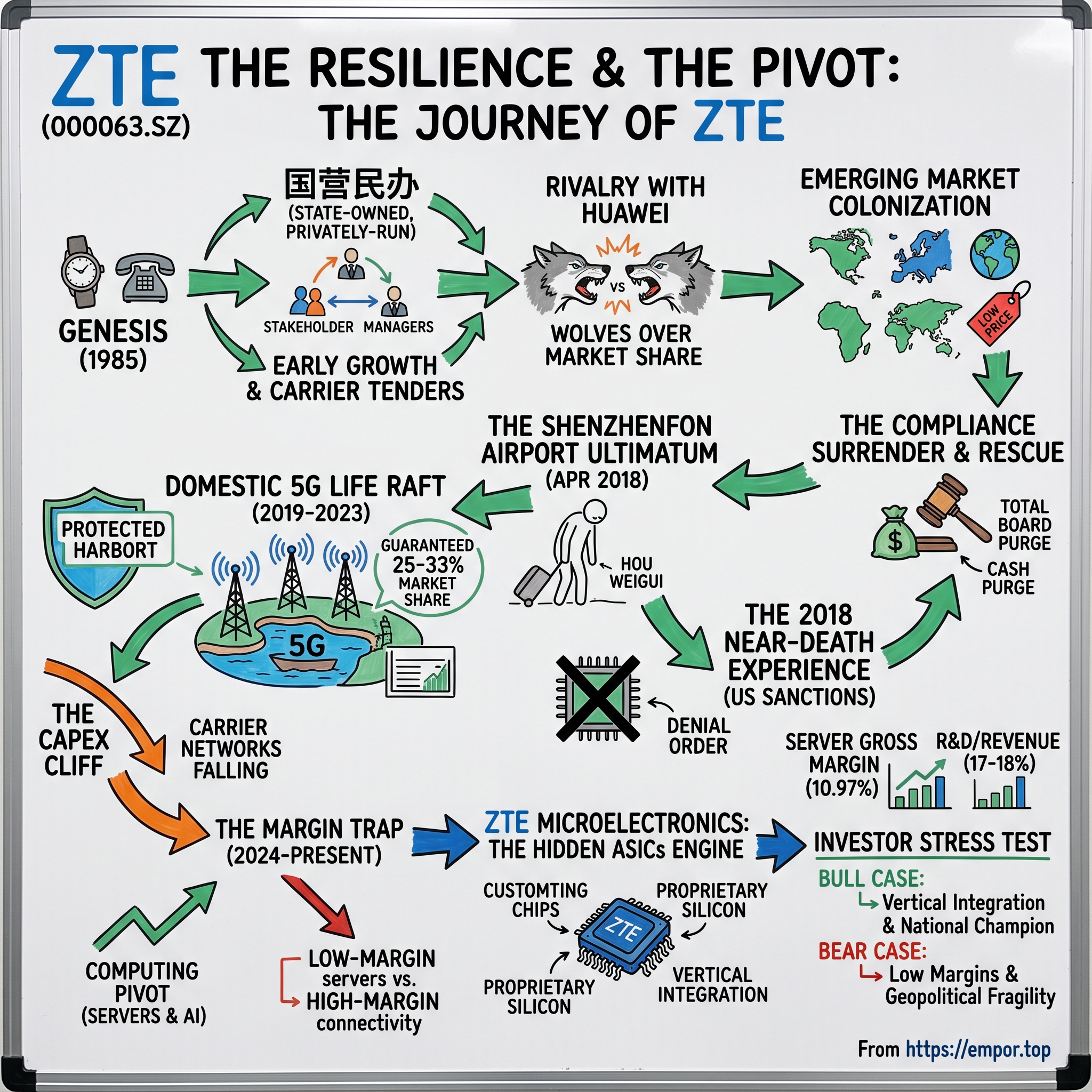
ZTE Corporation: The Resilience of China's "Other" Telecom Giant
I. Introduction: The Shenzhen Airport Ultimatum
Rewind to April 2018. To understand why the sight of Hou Weigui pushing a luggage cart went viral across Chinese social media, you have to understand what had just happened three days earlier and half a world away.
On April 16, 2018, the U.S. Department of Commerce's Bureau of Industry and Security — a small agency most people had never heard of — activated a seven-year "Denial Order" against ZTE. In plain language, it made it a violation of U.S. law for any American company to sell ZTE so much as a single semiconductor, a line of software, or a technical support call.2 For most companies, losing an American supplier is an inconvenience. For ZTE, it was a decapitation.
Here is the part that is easy to miss if you don't build telecom gear. A modern 5G base station — the refrigerator-sized box bolted to a cell tower that turns radio waves into internet — is not a Chinese product with a few American parts. At its heart sit components whose design and manufacturing the United States and its allies still dominate: the field-programmable gate arrays (FPGAs) that handle signal processing, the radio-frequency front-end chips that shape and amplify the wireless signal, the high-speed analog-to-digital converters, and the optical transceivers that move data through fiber. Strip those out and you do not have a slower base station. You have an empty metal box. ZTE's assembly lines, according to reporting at the time, began grinding to a halt within days.1
The company's stock was suspended from trading in both Shenzhen and Hong Kong. Its handset business, which relied on Qualcomm processors and Google's Android licenses, was frozen. Internally, executives described the order not as a fine or a setback but as an existential threat — a "death sentence" for a firm employing tens of thousands and supplying carriers in dozens of countries. ZTE's own public statement conceded the order would "severely impact the survival and development of the company."
So the founder came back. Hou Weigui had formally retired from the board years earlier, handing off to a younger generation. But in a crisis of legitimacy, a Chinese company reaches for its patriarch. The image of him hauling his own bag was pure semiotics — a message, to Washington and to Beijing simultaneously, that this was a company of humble engineers, not a geopolitical weapon.
The paradox at the center of this episode is worth stating plainly before we go further. How did a firm born inside China's military-aerospace complex — arguably the least commercial, least agile corner of the old planned economy — become a genuinely world-class builder of the most sophisticated wireless infrastructure on the planet? How did it then walk itself into a sanctions catastrophe of its own making? And how, having survived by surrendering its entire board to American oversight, is it now quietly attempting a second reinvention, from a connectivity company into a computing-power company, at the cost of the very margins that made it worth saving?
To answer that, we start not in Washington but in a Shenzhen that, in 1985, barely existed.
The four threads we will follow: first, the unusual "state-owned, privately-run" ownership structure that gave ZTE both political cover and commercial hunger. Second, the decades-long knife-fight with 华为 Huawei that forged its low-cost, emerging-markets playbook. Third, the 2018 sanctions and the total boardroom purge that followed. And fourth, the present-day pivot from connectivity to computing power — and the margin trap that pivot has sprung.
 Subscribe on LinkedIn
II. The Mixed-Ownership Genesis: Aerospace and "国营民办"
Picture Shenzhen in 1985. What is today a megacity of glass towers was then a construction site — a fishing-town-turned-experiment, designated a Special Economic Zone only five years earlier so that Deng Xiaoping's China could test capitalism behind a fence, at a safe distance from Beijing. Into this half-built frontier the Ministry of Aerospace Industry (航天部) dispatched a mid-career engineer named Hou Weigui to set up a small manufacturing venture, Zhongxing Semiconductor Co. (中兴半导体).
Hou was not a natural buccaneer. He was a methodical technical man, shaped by the disciplined, documentation-heavy culture of China's missile and satellite institutes. And the venture he was handed did not begin with grand ambitions in telecommunications. To generate cash and keep the lights on, the early operation assembled the low-end electronics that flowed through 1980s southern China: electronic watches, telephones, small consumer gadgets. This is a recurring pattern in the origin myths of great hardware companies — you survive on whatever sells while you look for the thing that matters.
Hou found the thing that mattered by looking at what China conspicuously did not control: the telephone switch. In the mid-1980s, a Chinese city that wanted a modern telephone exchange had to buy it from foreigners. The domestic market was carved up among Western and Japanese suppliers — Alcatel, Siemens, Ericsson, NEC, Fujitsu, and others — a situation Chinese engineers bitterly summarized as 七国八制, the "seven countries and eight systems." Eight incompatible foreign switching standards, none of them Chinese, all of them expensive. For a nationalist engineer, this was both an insult and an opportunity. If China was going to wire itself for the telephone age, someone was going to sell tens of millions of switch lines. Why not a domestic firm?
The problem was structural. A purely state-owned enterprise had the political backing and the financing but moved at the speed of a bureaucracy. A purely private firm had the hunger but, in 1980s China, neither the capital nor the political permission to compete for national infrastructure. Hou's answer — and it is the single most important thing to understand about ZTE — was to invent a hybrid.
The arrangement that emerged, and which persists in modified form to this day, is often shorthanded as 国营民办: "state-owned, privately-run." State-linked aerospace institutes — principally the 西安微电子技术研究所 Xi'an Microelectronics Technology Institute and an aerospace entity, 航天广宇 Aerospace Guangyu — provided the anchor capital and the political legitimacy, holding their stakes through a controlling vehicle called 中兴新 Zhongxingxin, which to this day sits atop the listed company as its largest shareholder. But operational control — the hiring, the product roadmaps, the day-to-day decisions and, crucially, the profit incentives for the founding engineers — was vested in a separate private company, 深圳市中兴维先通设备有限公司 Zhongxing WXT, owned by Hou and his core team.
Why does this matter to an investor rather than a corporate historian? Because it resolved, at least partially, the central tension of Chinese industrial policy: how to get state-scale backing without state-scale sclerosis. Zhongxingxin gave ZTE the things a private start-up in that era could never obtain on its own — access to state banks, priority in carrier procurement, and the implicit protection of being a "national champion" in a strategic sector. The private management vehicle gave the founders skin in the game and the freedom to run the company like a business rather than a work unit. It is a structure that Western investors often find bewildering and occasionally alarming, because it means the interests of the controlling shareholder are not purely commercial. But it is also, arguably, the reason ZTE existed at all.
The dualism has a darker read, too, and a neutral observer should hold both. The same state ties that provided cheap capital and a protected home market also made ZTE a natural instrument — and target — of state policy, a fact that would become catastrophically relevant three decades later when the question of who ZTE really answered to landed in a U.S. courtroom. A company that is politically insulated at home can be politically exposed abroad. Hold that thought.
It is worth pausing on how improbable the leap actually was. Going from assembling watches and telephones to designing a carrier-grade digital telephone switch is not an incremental step; it is a discontinuity. A switch is the brain of a telephone network, routing thousands of simultaneous calls, and in the 1980s the ability to build one was a mark of national technological maturity that most developing countries simply did not possess. Hou's bet was that a disciplined engineering team, working cheaply and patiently, could climb that curve fast enough to undercut the foreign incumbents before they noticed. It took years of unglamorous, iterative development — the aerospace-institute habit of documentation and testing turned toward a commercial product — but ZTE and its domestic peers gradually broke the 七国八制 foreign lock, first in smaller county and rural exchanges that the multinationals found too unprofitable to bother with, then working upward toward the lucrative urban networks. This is a classic disruption-from-below pattern: enter where the incumbents don't care to defend, build capability on low-margin volume, then move up. It is precisely the same playbook ZTE would later run against Ericsson and Nokia abroad, and, in an ironic mirror image, the same playbook Inspur and H3C are now running against ZTE in servers. The company was built on the low-end foothold — and it is now, in computing, on the receiving end of one.
The company listed its A-shares in Shenzhen in 1997 and added an H-share listing in Hong Kong in 2004, giving the world its dual 000063.SZ / 0763.HK identity. But long before it was a public company, ZTE had learned the habit that would define it: build good-enough gear, sell it cheap, and grind. That habit was about to be tested against the most feared competitor in Chinese business history — a rival born in the very same city, in the very same industry, at very nearly the very same time.
III. The Red-Eye Rivalry: ZTE vs. Huawei and the Global Push
If you want to understand ZTE, you have to understand the shadow it has lived inside for almost forty years. That shadow is Huawei.
The two companies are a study in contrasts so neat it almost feels scripted. Both were founded in Shenzhen in the mid-1980s. Both set out to break the foreign grip on Chinese telecom switching. Both went global. And yet in temperament they could hardly be more different — and that difference, more than any single product decision, explains why one became a $100-billion-plus revenue colossus and the other its perennial, respectable, roughly-one-third-the-size runner-up.
ZTE, under Hou Weigui, was the engineering academy. Cautious, process-driven, allergic to the kind of bet-the-company gambles that make legends. It was, in the words often used about it, run like an aerospace institute — because it was, quite literally, founded by one. Decisions were deliberate; risk was something to be managed, not embraced.
Huawei, under 任正非 Ren Zhengfei, a former People's Liberation Army engineer, was the opposite: aggressive, secretive, employee-owned, and animated by what the company itself proudly called 狼性文化, "wolf culture" — the idea that a company, like a wolf pack, survives by relentless pursuit, acute sensitivity to opportunity, and a willingness to fight in packs for every kill. Where ZTE optimized, Huawei attacked.
The rivalry became the stuff of Chinese business folklore. In domestic carrier tenders, the two firms bid each other into the ground, sometimes pricing at or below cost to deny the other a reference account. They litigated against each other. They poached each other's engineers. Chinese telecom executives learned to play them off one another, and the carriers — China Mobile, China Telecom, China Unicom — were the beneficiaries, extracting world-class equipment at prices that would have made Ericsson and Nokia weep.
But the more consequential story is what the two firms did together, without cooperating: they colonized the emerging-market world. Through the late 1990s and 2000s, ZTE pursued a strategy Beijing branded 走出去, "going out" — pushing into Africa, Latin America, Eastern Europe, the Middle East, and Southeast Asia. The pitch was devastatingly simple. A carrier in Ethiopia or Pakistan or Venezuela could buy a Western-branded network from Ericsson or Nokia at full price, or it could buy a carrier-grade ZTE network — switches, base stations, transmission gear — that did substantially the same job at a capital cost that ran, in many deals, 30 to 40 percent lower.
For a cash-strapped state telco, that was not a close call. And ZTE sweetened it further with a financing weapon Western vendors could not match: export credit lines arranged through the 国家开发银行 China Development Bank, which let a foreign carrier buy Chinese gear on long-dated, low-cost loans effectively underwritten by the Chinese state. The equipment sale and the financing came as a bundle. This is industrial policy operating as a sales tool, and it worked.
The "going out" strategy had a second front that is easy to forget today: handsets. On the back of its carrier relationships, ZTE became, for a stretch of the early 2010s, one of the larger smartphone makers on earth by volume — not through brand desire but through the carriers' side door, supplying the cheap, subsidized, carrier-branded Android phones that emerging-market operators handed to first-time smartphone buyers, and, in the United States, the low-end prepaid devices sold through operators like AT&T and T-Mobile. It was a volume business, not a margin business, and it was never beloved the way a consumer brand aspires to be. But it did two things. It gave ZTE genuine scale in consumer electronics, and — fatefully — it made the company deeply dependent on Qualcomm's processors and Google's Android licenses, two more American dependencies that would freeze solid the moment the Denial Order hit. The consumer business survived 2018, but it never fully recovered its former U.S. footprint; today it is the smaller, steadier third leg of the company, generating around RMB 33.82 billion in 2025, up a modest 4.4%.5 It is a reminder that ZTE's vulnerability was never confined to base stations — it ran through every product the company made.
There is a deeper piece of business physics underneath all of this, and it is the single most attractive feature of the telecom-equipment business: switching costs. Once a carrier builds its radio access network — the antennas and base stations that connect to your phone — and its core switching on one vendor's platform, ripping it out is not like changing a software subscription. It means sending crews to thousands of physical tower sites, recalibrating software, renegotiating spectrum and site permits, and risking network outages for millions of subscribers during the transition. The cost and risk of switching vendors is so high that carriers rarely do it. The incumbent vendor, having won the initial build, then wins the upgrades, the expansions, and the spare parts for a decade or more. Land the network, and you have annuitized a customer.
That is the moat ZTE built across dozens of countries — a portfolio of sticky, hard-to-dislodge carrier relationships bought with low prices and cheap Chinese credit. It is a genuinely good business. But notice its dependency, because it is the hinge of everything that follows. ZTE's low-cost gear was cost-competitive precisely because it was assembled from the best components the global supply chain offered — many of them American. The moat and the vulnerability were the same wall. Which brings us to the acquisition ZTE made just before that wall came down.
IV. Capital Allocation and Global Bets: Netaş and the Strategic M&A Era
Here is a useful tell about a company's character: watch what it does when it has money to spend. Some hardware firms, flush with cash and ambition, go on debt-fueled acquisition sprees, paying nosebleed premiums to buy their way into new geographies and technologies. The graveyard of telecom is full of them — the era's defining monument being the tortured, value-destroying merger of Alcatel and Lucent, two proud incumbents that combined mostly to share their decline. ZTE, for all its faults, was not that kind of buyer.
Its signature international acquisition is almost quaint in its modesty. In 2017, ZTE moved to acquire a controlling 48.04 percent stake in Netaş (Netaş Telekomünikasyon), a listed Turkish telecom systems integrator, buying the block from the private-equity owner One Equity Partners and a co-investor for roughly $101 million plus performance-based earnouts.9 Note the scale: a hundred million dollars. This was not an empire-building acquisition. It was a scalpel.
The logic was geographic and, tellingly, geopolitical. Turkey sits at the seam between Europe, Central Asia, and the Middle East. Netaş gave ZTE a locally-listed, locally-staffed engineering and integration arm inside a NATO member — a company that could localize products, employ Turkish engineers, and bid on infrastructure in a region where a wholly Chinese-branded supplier was increasingly viewed with suspicion. In an era when "Chinese telecom vendor" was becoming a national-security label in Western capitals, owning a respected local integrator was a way to soften the edges. Whether that premium was justified is debatable — ZTE paid up relative to other Turkish IT integrators — but the strategic rationale was coherent: buy a passport, not just a P&L.
The more important point is what ZTE did not do. It did not chase the transformational, credibility-buying megadeal. Through the optical and 3G booms, when valuations for anything with a fiber patent or a spectrum position ran hot, ZTE largely stayed home and reinvested. Its capital went overwhelmingly into two things: organic research and development, and building out its own in-house semiconductor design capability — the chip unit whose importance we will come to, because it turns out to be the most valuable strategic decision the company ever made.
For an investor, this is a genuinely double-edged trait. On the one hand, ZTE's relative capital discipline meant it never blew up its balance sheet on a bad acquisition, never wrote down billions of goodwill, never had to explain to shareholders why the transformational deal turned out to be a transformational mistake. Reinvesting in R&D and silicon rather than buying revenue is, over a long horizon, usually the higher-returning choice in a technology business. On the other hand, that same conservatism meant ZTE never bought its way to the scale that might have let it challenge Huawei or Ericsson at the very top of the market. It remained, by choice and by temperament, the disciplined number two.
There is a useful discipline in translating a trait like "reinvests in R&D rather than acquisitions" into what it actually buys. A company that grows its capability organically compounds institutional knowledge — the same engineers, working the same problems, year after year — rather than bolting on acquired teams that have to be integrated, retained, and culturally absorbed, a process that fails as often as it succeeds. It also means the value ZTE created stayed inside ZTE, embodied in patents, chip designs, and a deep bench of telecom engineers, rather than being paid out to the selling shareholders of acquisition targets. The cost of that patience is time and forgone scale; the benefit is a coherent, cumulative technology base that a roll-up can rarely match. For a business whose entire competitive premise is doing more engineering per dollar than its rivals, that is probably the right trade — and it is a quiet tell about a management culture that thinks in decades rather than deal cycles.
That discipline would matter enormously in what came next — because a company that had husbanded its balance sheet was a company that could, just barely, absorb a $1.4 billion hit and a total decapitation of its leadership without going under. It was about to need every yuan of that resilience. The bill for ZTE's greatest strategic vulnerability — its dependence on American technology, and its willingness to route that technology to places American law forbade — was about to come due.
V. The Near-Death Experience: The 2018 US Sanctions & The Compliance Surrender
Every corporate near-death experience has a moment where, in hindsight, the disaster becomes inevitable. For ZTE, that moment was not April 2018. It was years earlier, and it was entirely self-inflicted.
Go back to March 2017. After a multi-year investigation, ZTE pleaded guilty in U.S. federal court to a scheme that was, by the government's account, remarkably brazen. Over several years, the company had shipped U.S.-origin telecommunications equipment — gear stuffed with American chips and software — to Iran, in violation of U.S. sanctions, and had a parallel channel to North Korea. Worse, internal ZTE documents laid out how to do it: how to route the equipment through shell companies, how to scrub the paper trail, how to isolate the illicit business from scrutiny. The company agreed to pay a combined penalty of roughly $1.19 billion, of which $892 million was payable immediately, in what U.S. authorities called the largest criminal fine in an export-control case to that point.[^4][^5]
That should have been the end of it — an expensive lesson, dutifully absorbed. But the 2017 settlement carried conditions, and one of them was almost comically specific: ZTE had to discipline the employees responsible and claw back their bonuses. This was the compliance equivalent of a suspended sentence. Follow the terms, and the harshest penalties stayed on the shelf.
ZTE did not follow the terms. According to the Commerce Department, the company disciplined only a fraction of the responsible employees, quietly paid the very bonuses it had promised to claw back, and — the detail that turned a slap into a guillotine — then made false statements to the U.S. government about having done so.2 It is hard to overstate how self-destructive this was. ZTE had been caught, had confessed, had paid nearly a billion dollars, and had been handed a clear path to move on. It lied about a bonus clawback and detonated the whole arrangement.
On April 16, 2018, BIS activated the seven-year Denial Order.2 We have already seen what that meant on the factory floor. What is worth dwelling on is the mechanism, because it is the template for a decade of subsequent U.S. technology policy toward China. Washington did not tariff ZTE. It did not sue ZTE. It simply told every American company that dealing with ZTE was now illegal — and because the modern electronics supply chain runs on American design tools, American intellectual property, and American components, that single administrative act reached into base stations and smartphones on six continents. The lesson every Chinese technology executive drew, correctly, was that dependence on the American technology stack was a loaded gun that Washington could fire at will. The entire subsequent Chinese drive for semiconductor self-sufficiency traces, in no small part, to what happened to ZTE.
What happened next was one of the stranger episodes in the history of trade enforcement, and it complicates any tidy morality tale about the sanctions. In May 2018, with ZTE's lines still dark, the case was suddenly pulled out of the technocratic machinery of the Commerce Department and into the theater of presidential politics. U.S. President Donald Trump, in the middle of a broader trade negotiation with Beijing, publicly declared that he was working with President Xi Jinping to give ZTE "a way to get back into business, fast," lamenting that "too many jobs in China" had been lost — an astonishing statement from an American president about a Chinese company his own government had just sanctioned for lying about sanctions violations.3 For a few weeks, ZTE's fate became a bargaining chip in a great-power trade fight, its survival hostage to a negotiation over soybeans and tariffs that had nothing to do with Iran or bonus clawbacks.
That intervention is worth sitting with, because it cuts against the clean narrative in both directions. To the hawks, it looked like the United States had blinked, trading a genuine enforcement action for leverage elsewhere. To ZTE's defenders, it confirmed that the company had become collateral in a conflict far larger than itself. For an investor, the takeaway is colder and more durable: when your survival can be decided by a presidential tweet, you are not really running a company — you are running a geopolitical position. No amount of engineering excellence changes that.
The rescue, when it came in June 2018, was a surrender dressed as a settlement — and the terms were unprecedented in their intrusiveness.[^3] To lift the Denial Order, ZTE agreed to three things. First, money: an additional $1 billion civil penalty paid immediately, plus $400 million placed into escrow held by a U.S. bank, forfeitable on any future violation.[^3]3 Combined with the 2017 penalties, ZTE's total cash bill ran to roughly $2.3 billion — but the number that mattered operationally was the fresh $1.4 billion drained from the balance sheet in a single stroke.
Second, and more remarkable, governance. As a condition of survival, ZTE agreed to replace its entire board of directors and its senior leadership within 30 days.4 Not the culpable executives — everyone. On June 29, 2018, ZTE's shareholders convened and did exactly that, sweeping out the board wholesale to satisfy the American deadline.4 Imagine a foreign government dictating that an American company fire its entire board within a month or cease to exist. That is what happened, in reverse, to ZTE.
Third, and most extraordinary of all, the monitor. The settlement installed a team of independent compliance monitors — a Special Compliance Coordinator selected by and reporting to the U.S. Department of Commerce — physically embedded inside ZTE's headquarters for a period of up to ten years, with sweeping access to the company's records, communications, and supply-chain documentation.[^3] Read that again. An arm of the American government placed its own auditors inside the corporate nerve center of a Chinese state-linked national champion, and the Chinese firm agreed, because the alternative was liquidation. There is no cleaner illustration of the asymmetry of the global technology system as it existed in 2018: China could build the networks, but the United States held the off switch.
For investors, the enduring lesson is not the size of the fine. It is that for a company sitting on a geopolitical fault line, compliance is not an overhead cost — it is a foundational, existential asset. ZTE's engineers had built a multi-billion-dollar R&D portfolio and a global installed base. A single act of dishonesty about employee bonuses came within a hair of rendering all of it worthless. That is a risk that does not appear on any balance sheet, and it is permanently attached to this company.
The question, in the summer of 2018, was who would run the wreckage. The answer would be a leadership structure as unusual as the ownership structure that began this story.
VI. The Dual-Leadership Era & The Domestic 5G Buffer
When you are forced to replace your entire leadership under the supervision of a foreign government, the people you choose send a message. ZTE's choices in 2018 revealed exactly what the company understood its problem to be — and split the job of survival cleanly in two.
To the chairmanship went 李自学 Li Zixue, a figure drawn not from the ranks of celebrity CEOs but from the company's founding DNA: a director connected to the 西安微电子技术研究所 Xi'an Microelectronics Technology Institute, the state aerospace institute that had anchored ZTE's capital since 1985. Li was, in effect, the state's steady hand. His mandate was not product vision or growth. It was to manage the American monitors, steer the compliance overhaul, keep the political relationships intact, and protect the controlling shareholder's strategic interest. In a company on probation, the chairman's job was to make sure the probation was never violated again.
To the chief executive role went 徐子阳 Xu Ziyang, and here the message was different. Xu was a lifer — a roughly two-decade ZTE product and engineering veteran who had cut his teeth running the company's operations in Germany, one of the most demanding and standards-conscious telecom markets in the world. If Li was there to satisfy Washington and Beijing, Xu was there to keep the trains running: stabilize the core product lines, protect the R&D engine, and prove the company could still ship world-class gear while an American compliance team read its email.
This division of labor — a state-aligned chairman guarding the political flank, an operator CEO guarding the commercial one — has proven durable. Since 2018, the same pairing has held, and its narrative to investors has been strikingly consistent from year to year: rebuild trust, protect R&D, ride the domestic 5G wave, and prepare a second growth curve. On the question of management alignment, a neutral observer would note both a strength and a caveat. The strength: the compensation of the leadership has been heavily tied to net profit growth and, explicitly, to compliance discipline, and direct insider ownership is modest — Xu's personal direct stake is a fraction of a percent of the company, per ZTE's disclosures, so his incentives run through the option and performance schemes rather than a founder's control block.6 The caveat: in a company whose ultimate controller is a state-linked holding vehicle, "management alignment with minority shareholders" is always a partial story. The state's strategic objectives and a public shareholder's return objectives can diverge, and when they do, the ownership structure tells you who wins.
But leadership alone does not explain how ZTE survived. A company does not absorb a $1.4 billion cash drain, a total board purge, and an embedded foreign monitor while continuing to fund one of the largest R&D budgets in Chinese industry — unless something is generating a lot of reliable revenue in the background. That something was the Chinese 5G build-out, and it functioned, from roughly 2019 through 2023, as a state-sponsored life raft.
Here is the mechanism, and it is central to any honest assessment of ZTE. The rollout of 5G across China was not a free market. It was a coordinated national program, orchestrated by the Ministry of Industry and Information Technology, executed through the three state-owned carriers — China Mobile, China Telecom, and China Unicom — which spent staggering sums of capital expenditure building hundreds of thousands of 5G base stations on a compressed timeline. And in the tenders that allocated that spending, ZTE was consistently awarded a protected slice: broadly on the order of a quarter to a third of the domestic equipment market, with Huawei taking the lion's share above half and the Western vendors, Nokia and Ericsson, left to divide what remained.
Think about what a guaranteed quarter-to-third of the world's largest single telecom market does for a company on life support. It provides high, predictable volume — which lets ZTE spread its enormous fixed R&D and manufacturing overhead across a massive base, keeping unit costs down. It generates dependable cash flow to rebuild a battered balance sheet and pay down the penalties. And it does all of this regardless of how competitive ZTE is on the open market, because the allocation is, in part, an act of industrial policy: a strategic decision by the Chinese state to maintain two viable domestic telecom-equipment champions rather than let the sector collapse into a Huawei monopoly. ZTE, in this reading, survived less because of its own brilliance than because Beijing needed it to survive.
The scale of that raft is worth grasping concretely, because it is hard to overstate. China built the largest 5G network on the planet by a wide margin, standing up millions of 5G base stations in the space of a few years — a build-out with no historical parallel in telecom. A guaranteed share of that program was not a contract; it was a firehose. It let ZTE do something almost no company recovering from a near-death event ever gets to do: rebuild while its most important market was in the single largest expansion of its history. The financial recovery through 2019-2023 — the repaired balance sheet, the restored profitability, the sustained heavy R&D — was real and creditable, but it should be read against that backdrop. ZTE executed well; it also executed with a tailwind that few restructurings ever enjoy.
This is a good place for a myth-versus-reality correction, because a lazy consensus has hardened around ZTE in both directions. The Western myth is that ZTE is a hollowed-out, permanently crippled company, a cautionary tale that never really recovered from 2018. The reality is that it recovered its finances quite thoroughly and remained a top-tier global equipment vendor throughout. The opposing myth, popular in bullish Chinese coverage, is that ZTE is a triumphant, self-sufficient technology champion that has broken free of foreign dependence. The reality, as 2025's margins show, is that it remains deeply exposed to foreign silicon and is now grinding through a low-margin transition with no guaranteed outcome. Neither myth survives contact with the numbers. The truth is a company that is neither broken nor triumphant — durable, resourceful, and still structurally constrained.
That is the bull and the bear case fused into a single fact. The protected home market is a genuine, durable competitive advantage — a volume base most global competitors would envy. It is also a dependency, and a signal that ZTE's fortunes are only partly in its own hands. And a life raft, by definition, is for getting through a storm, not for crossing an ocean. By 2024, the storm had passed — and so had the wave. China's 5G network was largely built. The question ZTE now faced was the one every infrastructure supplier eventually confronts: what do you sell when the building is finished?
VII. The "Connectivity + Computing Power" Pivot: Entering the Margin Trap
Every network build-out ends the same way. For years the orders pour in — antennas, base stations, core switches, transmission gear — and then, almost overnight, the network is complete and the orders stop. The infrastructure supplier that spent a decade riding the wave discovers it is standing on dry sand. Telecom veterans call it the capex cliff, and by 2024, ZTE had walked straight off the edge of one.
The numbers tell the story cleanly, and this is a case where the numbers demand an explanation rather than just a recitation. ZTE's Carriers' Network segment — the 5G-and-fiber connectivity business that had been its lifeblood — went into structural decline. In the company's 2025 results, operator-network revenue fell 10.62% to roughly RMB 62.86 billion, and that came on top of a steep drop the year before.57 This was not a bad quarter or a cyclical dip. It was the predictable exhaustion of a national build-out, and management knew it was coming. The core moat — sticky, high-margin carrier connectivity — was doing exactly what a completed infrastructure market does. It was shrinking.
So Xu Ziyang did what a cornered hardware company must do: he pointed the entire R&D apparatus at a second growth curve. The strategy got a slogan — "Connectivity + Computing Power" — and a direction: pour the company's engineering muscle into artificial intelligence, cloud computing, high-performance servers (including liquid-cooled systems for AI data centers), and distributed storage. If carriers had stopped buying radios, ZTE would sell the picks and shovels of the AI boom instead.
On the top line, it worked spectacularly. In 2025, ZTE's Government and Corporate Business — the segment housing the server and computing push — roughly doubled, growing about 100% year-on-year to approximately RMB 37.22 billion.57 Within it, the company reported that server and storage revenue grew more than 200%, and its broader computing revenue rose around 150% to make up nearly a quarter of total company sales.5 The pivot lifted total 2025 revenue 10.4% to RMB 133.90 billion — a genuinely impressive headline for a company whose core business was in decline.5 On the surface, this looks like one of the great corporate reinventions: a telecom-equipment maker gracefully rotating into the highest-growth market on earth.
And then you get to the bottom line, and the story inverts. In the very same year that revenue grew double digits, ZTE's net profit attributable to ordinary shareholders collapsed by 33.32%, to roughly RMB 5.62 billion.578 Grow the top line 10%, shrink the bottom line by a third. That divergence is the whole story, and it has a name: the margin trap.
Here is the mechanism in plain terms. ZTE was swapping high-margin revenue for low-margin revenue as fast as it could, and the mix shift crushed profitability even as sales rose. The dying carrier business is extraordinarily profitable: its gross margin ran around 48% in 2025, the reward for a decade of proprietary technology and sticky, hard-won carrier relationships.7 The booming server business is the opposite: its gross margin was a razor-thin 10.97%.7 Every yuan of connectivity revenue ZTE lost was a fat, 48-cent-margin yuan; every yuan of server revenue it gained was a lean, 11-cent-margin yuan. You can grow revenue all day making that trade and still watch profit evaporate.
Why are servers such a miserable business? Two reasons, and management was candid about both. First, competition. In the Chinese server market, ZTE is a late-arriving challenger swinging at entrenched incumbents — 浪潮 Inspur, 新华三 H3C, and 联想 Lenovo — in a product category that is largely commoditized. When your product is a standardized box of other companies' chips, the only lever you have to win data-center share is price, and ZTE has been discounting aggressively to buy its way in. Second, and this is the pincer, input costs. The most expensive components in an AI server are the processors and, increasingly, the memory — and through 2025, memory-chip prices surged, driven by the same AI boom fueling server demand.7 ZTE's customers for these servers are powerful — large internet companies and government buyers with enormous bargaining power — so the company could not simply pass the rising costs through. It absorbed them. Squeezed between commoditized pricing on one side and inflating component costs on the other, the server business earns almost nothing at the gross line, before it even pays for R&D and overhead.
There is a subtler point worth making for the fundamental investor. This is not necessarily bad management — it may well be the least-bad option. Standing still while the carrier business declined would have meant slow shrinkage into irrelevance. Buying share in computing, even at terrible margins, buys ZTE a seat at the table of the market that will define the next decade, and creates the possibility — the possibility — of later improving those margins with its own silicon and higher-value software. But an investor should be clear-eyed that this is a bet, not an achievement. So far, the reinvention has proven ZTE can grow revenue in computing. It has not yet proven ZTE can make money there. The top line says "successful pivot." The bottom line says "unproven and, for now, value-dilutive." Both are true.
There is one more layer worth exposing, because it tests management credibility. In its 2025 disclosures and results commentary, ZTE framed the profit collapse in exactly the terms above — mix shift toward computing, rising memory costs, powerful customers limiting pass-through — and it is, to management's credit, a candid and accurate diagnosis rather than a deflection.7 A management team that clearly names why it is losing profitability, rather than hiding behind "investment for growth" boilerplate, is easier to trust than one that doesn't. But candor about a problem is not the same as a credible plan to solve it, and the two should not be conflated. The company also leaned on financial-investment gains and trimmed some spending to cushion reported earnings — the after-extraordinary-items net profit was a much thinner RMB 3.37 billion, well below the headline RMB 5.62 billion, which tells you how much of the "profit" that remained was non-operating in nature.5 The quality of ZTE's earnings, in other words, softened even more than the headline decline suggests. That is the kind of detail a skeptical investor circles: when reported profit is falling and an even larger share of what's left comes from investment gains rather than the core business, the underlying operating deterioration is worse than the top-line number admits.
The dividend policy sends its own signal. The board proposed a final cash payout representing 35% of attributable net profit for 2025 — a decision to keep returning cash to shareholders even through a profit trough.57 Read charitably, it is a statement of confidence and a nod to the state and minority owners who value the income. Read skeptically, it is cash leaving a business that is simultaneously pleading for heavy investment to fund its computing pivot. Both readings are legitimate; which one is right depends entirely on whether the pivot pays off.
Which raises the question the bulls hang everything on: does ZTE have a way to fix the margins? The answer, if there is one, lives inside a subsidiary most investors have never heard of.
VIII. ZTE Microelectronics: The Hidden ASIC Engine
Every hardware company that survives long enough eventually confronts the same truth: the value migrates to the chips. And the single most consequential thing ZTE ever built is not a network or a phone. It is a chip-design house most of the market ignores, tucked inside the company as a wholly-owned subsidiary: 中兴微电子 ZTE Microelectronics (深圳市中兴微电子技术有限公司).
To understand why it matters, you need one concept: the ASIC. Most electronics run on general-purpose chips you can buy off the shelf — a Qualcomm processor, an Intel FPGA. They are flexible, but flexibility is expensive: you pay the merchant chipmaker its margin, and you get the same silicon your competitors can buy. An Application-Specific Integrated Circuit, or ASIC, is the opposite: a chip you design yourself to do exactly one job — process a 5G baseband signal, switch data packets at enormous speed — and nothing else. Designed well, an ASIC is faster, more power-efficient, and, critically, far cheaper per unit than cobbling the same function together from general-purpose parts. The catch is that designing one requires a world-class chip team and years of investment. Most equipment vendors don't have that, so they buy merchant silicon and eat the margin hit. ZTE built the team.
The strategic importance of that decision was thrown into relief by ZTE's Western competitors' struggles. When Nokia rolled out its early 5G products, it leaned on general-purpose Intel FPGAs rather than its own custom silicon — its in-house "ReefShark" ASICs arrived late — and the result was 5G gear that ran hotter, drew more power, and cost more to build than the custom-silicon alternative. Nokia spent years and a great deal of money digging out of that hole. ZTE, by contrast, could tap its own microelectronics arm for optimized, low-cost proprietary chips, which is a meaningful part of why its connectivity gross margins held up near 48% while it fought a price war at home.
Then came the moment that revealed how ZTE itself valued this asset. In September 2020 — two years into the compliance ordeal, with the balance sheet still healing — ZTE spent RMB 3.315 billion (about $487 million) through a subsidiary, Renxing Technology, to buy back the 24% minority stake in ZTE Microelectronics held by the state-backed National Integrated Circuit Fund (the 大基金, or "Big Fund"), restoring full 100% ownership of the chip unit.[^8] Think about the priorities that reveals. A company still under American probation, still rebuilding its cash position, chose to spend nearly half a billion dollars not on a flashy acquisition or a dividend but on consolidating ownership of its own silicon. It was buying back control of the one asset it judged most strategic.
The transaction implied a valuation of roughly RMB 13.8 billion for the whole microelectronics unit.[^8] A number of analysts argued at the time that this figure dramatically understated its strategic worth — that a captive, advanced chip-design house, in a world where China's access to foreign silicon was becoming a matter of national survival, was worth far more than a mechanical valuation suggested. Whether or not that is right, the buyback tells you where ZTE's conviction lay.
And today, that conviction is being redirected at the margin problem from Section VII. ZTE Microelectronics has moved beyond telecom baseband into exactly the silicon its new businesses need: high-speed data-center switching chips at the leading edge of bandwidth (in the 51.2-terabit class that top-tier networking silicon now targets), and proprietary AI processors — branded 珠峰 (Zhufeng, "Everest") — aimed at the inference and computing workloads that its server lines are built to run. The strategic logic is elegant on paper: if the reason ZTE's servers make no money is that it must buy expensive third-party processors and memory, then designing more of that silicon in-house could, over time, claw back margin and differentiate a commoditized box.
Here is where a neutral analyst must apply the brakes, though. That is the theory. The evidence that ZTE Microelectronics can actually design AI accelerators competitive with the merchant leaders — at the process nodes available to a Chinese fabless firm operating under export restrictions — is not yet in. Designing a high-speed switch ASIC, which ZTE has genuinely done well, is a different and more tractable problem than fielding a data-center AI processor that customers will choose over the alternatives. The chip arm is unquestionably ZTE's most important strategic asset and its best hope of escaping the margin trap. It is not yet proof that the escape will work. It is a cornered resource with real optionality and real uncertainty attached — which is exactly how a disciplined investor should hold it.
That tension — a genuine, hard-to-replicate advantage sitting right next to a set of unproven bets — is the perfect frame for stepping back and assessing where ZTE's power actually comes from.
IX. Playbook: Hamilton Helmer's 7 Powers and Strategic Lessons
Strip away the geopolitics and the drama, and an investor is left with a simpler question: where, if anywhere, does ZTE possess durable competitive advantage — the kind that persists even when a competitor understands it perfectly and tries to compete it away? Hamilton Helmer's "7 Powers" framework is a useful scalpel here, precisely because it forces you to separate real, structural power from the mere appearance of it. ZTE is an unusually clean case study, because its power is strong in exactly the businesses that are shrinking and weak in exactly the businesses that are growing.
Start with the Cornered Resource, where ZTE scores highest. ZTE Microelectronics is the genuine article — a captive, advanced silicon-design capability that competitors cannot easily replicate, because they would have to build a comparable chip team from scratch or keep paying merchant suppliers their margin. In telecom baseband and high-speed switching, this is a real and durable edge, the reason ZTE's connectivity margins are structurally healthier than a pure box-assembler's would be. The important caveat, established already: this power is proven in switching and baseband, and only aspirational in AI computing.
Next, Scale Economies, where ZTE rates a solid medium. It is a fraction of Huawei's size globally, so it does not have absolute scale leadership. But its protected quarter-to-third slice of the vast Chinese carrier market gives it enough guaranteed volume to amortize an enormous fixed R&D budget — RMB 22.76 billion in 2025, roughly 17% of revenue — across a reliable base.5 That is real scale power within its home market, though it is scale granted partly by policy rather than won purely by competition, which makes it more contingent than the scale advantage of, say, a global platform.
Switching Costs are high — but again, concentrated in the legacy business. As we saw, ripping out an installed carrier network is so costly and risky that incumbents rarely get displaced. This is a powerful, annuity-like advantage. The uncomfortable point for the bull case is that this high-switching-cost business is the one in structural decline. The moat is deep; the water behind it is draining.
And then Counter-Positioning, where ZTE scores low, and honestly should. In the server and computing business, ZTE has no structural advantage that incumbents cannot match. It is not doing something Inspur or H3C or Lenovo cannot copy without harming their existing business — the classic counter-positioning setup. It is simply a late entrant playing a standard, capital-intensive, scale-and-price game against entrenched rivals, which is exactly why its margins are so thin. There is no clever asymmetry protecting it here. It is grinding.
The other three powers — Network Economies, Branding, and Process Power — are largely not applicable or not material to ZTE's situation, and it would be padding to pretend otherwise. Telecom equipment has weak network effects, ZTE's brand carries no pricing premium (its whole pitch is being cheaper), and while its aerospace-institute engineering discipline is real, it does not constitute the kind of hard-to-replicate process advantage that meaningfully bends economics.
Run through Porter's five forces and you get the same shape from a different angle. Supplier power over ZTE is dangerously high — the entire 2018 crisis was a demonstration of just how much power upstream American technology suppliers held, and the memory-price squeeze of 2025 is a gentler version of the same lesson. Buyer power is high and rising: three state carriers on one side, a handful of giant internet and government buyers for servers on the other, all able to dictate terms. Rivalry is ferocious in both segments. The one force working in ZTE's favor is the threat of new entrants in telecom infrastructure, which is genuinely low — the technical and switching-cost barriers to building carrier-grade RAN are enormous, which is why the global market has consolidated to a handful of players. ZTE's fortress is the connectivity business; the computing business is an open field where it is one soldier among many.
Two durable lessons fall out of the ZTE story for any long-term investor, and they generalize well beyond this one company. The first: in an age of technological decoupling, compliance is an existential asset, not a cost center. A single regulatory slip nearly vaporized decades of R&D value. The second, and the more analytically useful: beware the second curve. When a company transitions from a high-margin legacy moat to a low-barrier, high-competition growth market, the top line can look triumphant while the unit economics quietly collapse. Revenue growth and value creation are not the same thing, and ZTE's 2025 results are a near-perfect illustration of the gap between them.
So how should a skeptical investor actually weigh all this? Time to put the bull and bear cases in the ring.
X. The Investor Stress Test: Bull vs. Bear & Key KPIs
Let's do what a good analyst does with a company like this: build the strongest possible case for each side, then decide what evidence would move you.
The bear case — ZTE is structurally trapped. Start with the shape of the business. Its most profitable engine, carrier connectivity, is in a durable cyclical-to-structural decline, and there is no domestic 5G build-out coming to rescue it a second time; the next wave, 5.5G/6G, is years off and unlikely to match the scale of what just ended. Meanwhile the business ZTE is pouring resources into — servers and computing — is a low-margin, commoditized trap that consumed enormous working capital to earn an 11% gross margin and helped drive a one-third collapse in net profit in 2025.78 A skeptical short-seller would frame it bluntly: ZTE is selling dollars of high-quality profit and replacing them with dimes of low-quality revenue, and calling the resulting revenue growth a turnaround.
The bear then twists the knife on the dependency. To build those AI servers, ZTE still relies on high-performance foreign silicon it cannot fully substitute — the same structural vulnerability that nearly killed it in 2018, now re-created in a new product line. If U.S. export controls tighten further, or if the embedded compliance regime detects any drift, ZTE is once again exposed to a switch it does not control. Add the governance overhang: a company whose ultimate controller is a state-linked entity, whose home-market advantage is a policy grant rather than a market victory, and whose interests may not always align with minority holders. That is a lot of fragility stacked in one name.
The bull case — the resilient national champion. Now the other side, and it is not weak. ZTE is a core beneficiary of a genuine, multi-decade national priority: 东数西算, the "East Data, West Computing" program to build out China's data-center and computing backbone, channeling AI workloads from the coastal east to power-rich western regions. As that build-out standardizes on exactly the liquid-cooled, green-data-center architecture ZTE has been racing to supply, ZTE's ability to offer an end-to-end "connectivity plus computing" portfolio — network, servers, storage, and increasingly its own chips — gives it a systems-integration position few pure-play server vendors can match. The market it is buying into at bad margins today is the market that will define Chinese technology infrastructure for a generation.
And the bull's trump card is the one from Section VIII: vertical integration into silicon. If ZTE Microelectronics can, over time, replace expensive third-party processors and memory-heavy designs with proprietary, optimized chips — the Zhufeng line and its switching silicon — then the very input costs crushing server margins today become an internal transfer tomorrow, and the segment margin could climb from the low teens toward something respectable. The bull sees 2025's ugly margin not as the destination but as the trough of an investment phase — buy share now, integrate silicon later, harvest margin after.
There is a live overhang that sharpens the bear's dependency argument and deserves an explicit place on the risk radar: the compliance regime itself is a clock, and it is winding down. The suspended seven-year denial order and the multi-year probation and monitorship imposed in 2017-2018 were designed to run for a defined period, with the embedded oversight lapsing around the end of the decade. On paper, the expiry of external supervision removes a constraint. But it cuts the other way too. As long as the American monitors sat in ZTE's lobby, the company had both a powerful incentive and an ironclad excuse to be scrupulously clean, and a documented compliance apparatus that reassured every Western supplier and partner. Once that scaffolding comes down, ZTE must prove it has internalized the discipline rather than merely performed it under supervision — and it does so in a far more hostile export-control environment than existed in 2018, one where the U.S. restricted-entity toolkit has grown vastly more expansive. The end of the monitorship is not obviously a positive catalyst; it is the moment the company's compliance culture stops being audited and starts being tested. A skeptic would want several clean years on the other side before treating the 2018 chapter as truly closed.
Notice that the bull and bear are not really arguing about facts. They agree on every number. They disagree about one thing: whether ZTE Microelectronics can deliver competitive computing silicon fast enough to rescue the margins before the low-margin server business does lasting damage to returns. That is the entire debate, and it is not yet resolvable from the outside. Which is precisely why the honest posture here is neither champion nor short-seller, but watchful.
So watch these three things — the KPIs that will settle the argument. First and most important: the Government and Corporate (server) gross margin. It sat at 10.97% in 2025.7 The single cleanest test of whether the whole strategy is working is whether that number climbs — toward the high teens and beyond — as ZTE integrates its own silicon and moves up the value chain. If it drifts sideways or falls, the bear is right and ZTE is buying revenue it cannot monetize. If it steadily rises, the bull thesis is validating in real time. This is the number to circle.
Second: R&D efficiency — R&D as a share of revenue has run around 17-18%, an enormous, sustained commitment.5 The question is qualitative but trackable: is that spend producing proprietary, high-margin IP (chips, software, differentiated systems that lift margins), or is it merely defensive spending required to stay in the game? The proof will show up, over time, in whether ZTE's blended gross margin stabilizes despite the mix shift toward computing.
Third: non-China revenue. ZTE remains heavily domestic — well over two-thirds of revenue comes from China. In a decoupling world, its ability to hold or grow carrier revenue in the non-aligned emerging markets it spent decades cultivating is the tell for whether it can remain a global player or shrinks into a domestic-only champion. Rising international revenue would signal that the "going out" moat still holds; a steady retreat would confirm the walls are closing in.
XI. Outro
So what, in the end, is ZTE?
It is not the sinister arm of the Chinese state that its worst critics imagine, and it is not the invincible technology champion of its own investor decks. It is something more human and more instructive than either: a pragmatic, methodical, twice-humbled hardware company that has spent forty years being very good at being number two — and that bought its own survival, once, with a $2.3 billion bill and the extraordinary indignity of an American compliance team reading its email inside its own headquarters.[^3]3
Today it is attempting the hardest trick in business: swapping the fat, fading profits of the 5G antenna for the thin, brutal margins of the AI data center, and betting that its hidden chip arm can, over years, turn those thin margins fat again. The top line says the pivot is working. The bottom line says the jury is out. Both are the truth, and the gap between them is the investment.
ZTE endures because a great engineering culture, a protected home market, and one genuinely valuable silicon asset have so far been enough to outrun its vulnerabilities. Whether that remains true through the computing transition is the open question — and it makes ZTE one of the clearest case studies anywhere in the geopolitics, and the plain hard economics, of modern technology.
References
-
How ZTE was brought to the brink of collapse — Financial Times, 2018-05-04 ↩
-
U.S. imposes seven-year ban on sales to China's ZTE — Reuters, 2018-04-16 ↩↩↩
-
ZTE Reaches Deal With U.S. to Lift Ban, Commerce Says — Bloomberg, 2018-06-07 ↩↩↩
-
ZTE Shareholders Replace Entire Board to Meet U.S. Settlement Deal — Wall Street Journal, 2018-06-29 ↩↩
-
ZTE Reports 2025 Revenue of RMB 133.90 Billion, Advancing Full-stack AI Capabilities — ZTE Corporation, 2026-03 ↩↩↩↩↩↩↩↩↩↩
-
ZTE Corporation Corporate Announcements & Filings (incl. 2025 Annual Report and share option incentive scheme) — ZTE Corporation ↩
-
ZTE Corporation 2025 Annual Report and results filings (stock code 000063) — CNINFO Shenzhen Stock Exchange Information Disclosure Platform ↩↩↩↩↩↩↩↩↩↩
-
ZTE earnings fall by a third as costs soar — Light Reading, 2026-03 ↩↩
-
ZTE to acquire 48% stake in Turkey's Netas — DataCenterDynamics, 2017 ↩
 LinkedIn
 WhatsApp
 Reddit
 Hacker News
 Email
Email Kindle
 RSS Feed
 Spotify
 Apple Podcasts
 Amazon Music
 Audible
 YouTube