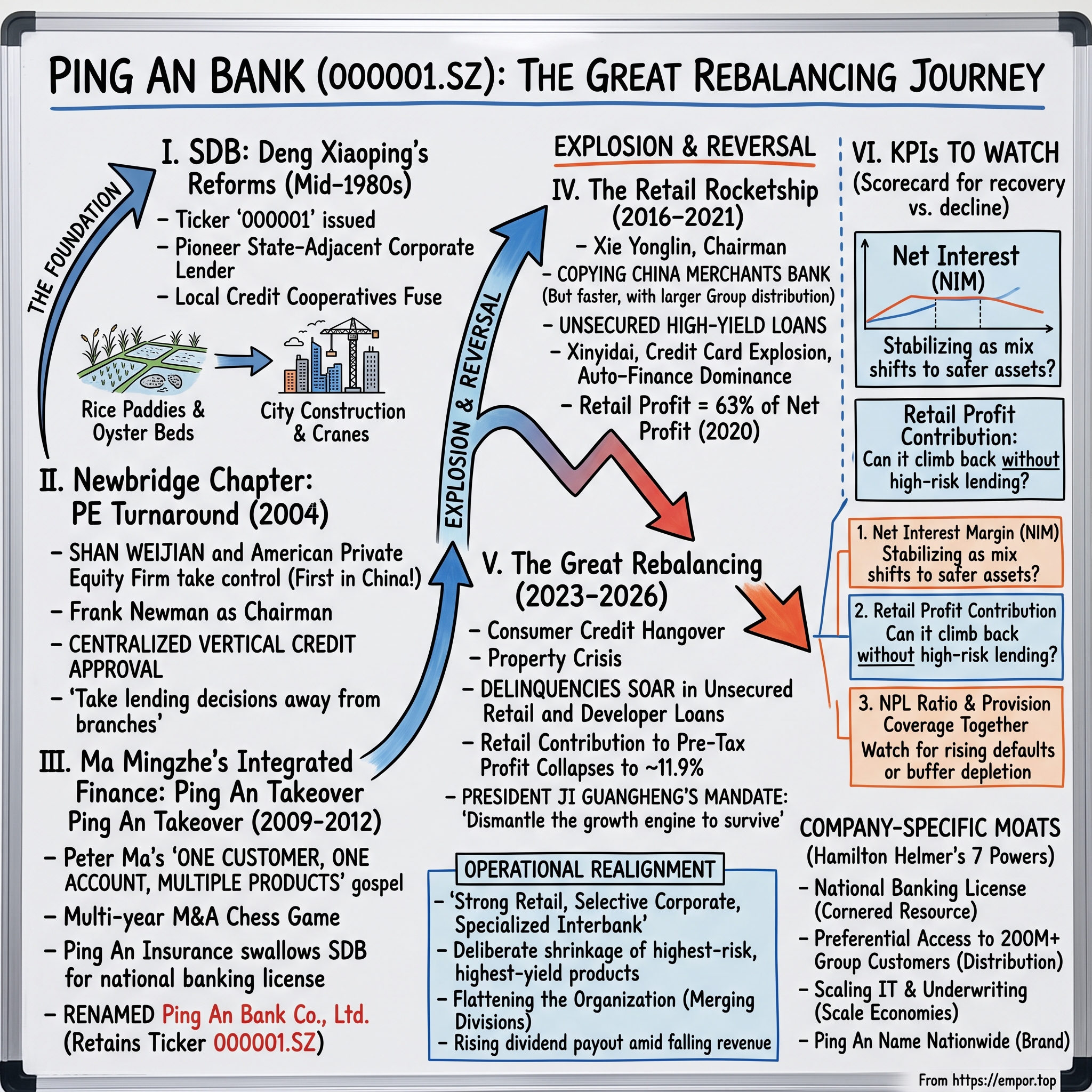
Ping An Bank: The Ultimate Financial Alchemist and the Great Rebalancing
I. Introduction & Episode Roadmap: The Ticker that Started It All
There is a number on the Shenzhen Stock Exchange that carries more history than any other: 000001.SZ. It is the very first ticker the exchange ever issued, the digital equivalent of a founding charter. When you punch it into a terminal today you get 平安银行股份有限公司 Ping An Bank Co., Ltd., a lender sitting on roughly RMB 5.77 trillion in assets — north of $800 billion — and one of the twelve national joint-stock commercial banks that form the ambitious, restless middle tier of Chinese finance.1
But that ticker was not born a Ping An asset. In 1987, it belonged to 深圳发展银行 Shenzhen Development Bank (SDB), a scrappy local lender stitched together from a handful of Shenzhen credit cooperatives at the exact moment 邓小平 Deng Xiaoping was turning a fishing town on the Hong Kong border into the laboratory of Chinese capitalism.[^2] SDB was, in a very literal sense, the first publicly traded commercial bank in the People's Republic — the guinea pig of an entire financial system learning to price risk.
Here is the paradox that makes this story worth telling. How does a pioneering, state-adjacent corporate lender end up rescued by American private equity, then swallowed by China's largest insurance conglomerate, then reborn as an aggressive consumer-credit machine, and then — barely a decade later — forced to tear down that very machine and rebuild itself for a harsher world? The arc runs through four distinct companies wearing one ticker. Each transformation was a bet on a different theory of how to make money in China, and each theory eventually collided with reality.
This is not a victory lap. Empor tells the stories of top companies without carrying water for their investor-relations departments, and Ping An Bank in 2026 is a company mid-restructuring, with a share price stuck well below book value and a strategy that is explicitly about doing less of what once made it exciting. The interesting question is not whether management is optimistic — management is always optimistic — but whether the evidence supports the turn they are making, and what would prove them wrong.
There is a broader reason this particular bank rewards close study. Ping An Bank is not a sleepy state giant coasting on a protected franchise, nor a fintech disruptor with no balance sheet. It sits in the contested middle of Chinese finance, the joint-stock tier, where banks are commercial enough to make real strategic choices but not large enough to be immune from the consequences. That makes it a near-perfect natural experiment in the questions every bank investor eventually confronts: How much is a distribution advantage really worth? Can technology outrun the credit cycle? What happens when a bank optimizes for growth and the environment demands survival? Ping An Bank has, across two decades, answered each of those questions the hard way — with real money, in real time. Its story is unusually legible precisely because it has lived through so many regimes wearing the same ticker.
Here is the roadmap:
- The Pioneer Era. SDB as the test subject of Chinese banking liberalization, and the crisis of bad debt that nearly killed it.
- The Newbridge Chapter. The first time a foreign private-equity firm was allowed to take control of a Chinese national bank — the deal that made
单伟建 Shan Weijiana legend. - The Merger Masterclass. How
马明哲 Ma Mingzhe(Peter Ma) of中国平安 Ping An Insurancepulled off a multi-year chess game to capture a national banking license and the country's most symbolic ticker. - The Retail Rocket (2016–2021). Going all-in on credit cards, unsecured consumer loans, auto finance, and cross-selling to Ping An's ocean of insurance customers.
- The Great Rebalancing (2023–2026). The consumer-credit hangover, the property crisis, and how President
冀光恒 Ji Guanghengdismantled the growth engine to survive.
Let's start where the ticker started.
 Subscribe on LinkedIn
II. The Birth of a Pioneer: SDB & Deng Xiaoping's Reforms
Picture Shenzhen in the mid-1980s. A decade earlier it had been rice paddies and oyster beds; now it was a construction site the size of a city, cranes silhouetted against the Pearl River Delta haze, migrant workers pouring in from the interior. Deng Xiaoping had designated it China's flagship Special Economic Zone — the place where the Communist Party would run its most audacious experiment: could you bolt a market economy onto a socialist state without the whole thing flying apart?
Banking was the hardest part of that experiment. In the early 1980s, Chinese finance was essentially a single cashier's window. The state-owned "Big Four" — 中国工商银行 ICBC, 中国农业银行 Agricultural Bank of China, 中国银行 Bank of China, and 中国建设银行 China Construction Bank — did not really lend in any capitalist sense. They disbursed credit where the plan told them to, to state-owned enterprises that repaid when convenient. There was no meaningful concept of underwriting, no price of risk, no penalty for a bad loan. Money in a planned economy is just an accounting entry that follows the plan; in a market economy it is a scarce resource that has to be allocated to its most productive use by someone with skin in the game. China was trying to make that leap, and it had no institutions built for it. To grow an entrepreneurial economy — the thousands of small factories, traders, and workshops springing up in Shenzhen — the zone needed something the Big Four could not provide: a bank that behaved like a bank, that would actually assess a borrower and price a loan.
The answer was the joint-stock commercial bank — an institution with shareholders, a profit motive, and at least the theoretical discipline of ownership. In 1987, Shenzhen fused five local credit cooperatives into one such entity: Shenzhen Development Bank.[^2] It was small, provincial, and improbable, but it had one thing no incumbent had: it was allowed to sell shares to the public. When the Shenzhen Stock Exchange formalized trading around 1990–1991, SDB's stock took the inaugural code — 000001 — and became a folk symbol of China's capitalist awakening. Retail investors treated it almost like a lottery ticket on reform itself.[^2]
That romance obscured a structural flaw that would nearly destroy the bank. SDB had the form of a modern lender without the substance. It had shareholders but no serious credit culture; branches but no centralized risk control; a growing loan book but no honest way to measure which of those loans would ever come back. Lending decisions were made locally, often shaped by relationships with municipal officials and the same state-owned enterprises the joint-stock model was supposed to route around. When a branch manager and a local SOE boss shared a banquet table, the loan tended to get approved. This is the oldest failure mode in banking, and China's pioneer walked straight into it.
Through the 1990s the bill came due. As the SOE sector groaned under overcapacity and reform, borrowers stopped paying, and SDB's balance sheet filled up with non-performing loans — credit extended against collateral that had evaporated and cash flows that never materialized. By the turn of the millennium the bank was carrying a mountain of bad debt that its thin capital base could not absorb. By 2003, SDB was, for practical purposes, insolvent: undercapitalized, hemorrhaging, and boxed in by regulators who forbade it from expanding until it cleaned house.2
It is worth pausing on why the bad debt was so hard to fix from the inside, because it explains everything that follows. A Western bank in trouble can raise capital, fire management, and tighten underwriting. SDB could do none of those things cleanly. Its shareholders included municipal entities whose interests were tangled up with the very borrowers defaulting on the loans. Its branch managers answered, informally, to local power structures. Its regulators wanted the problem solved but were wary of any solution that looked like ceding control. The bank was simultaneously too commercial to be bailed out like a state organ and too politically embedded to be run like a private company. It was stuck in the awkward middle of China's half-finished reform — a market institution operating inside a system that had not yet decided how much market it wanted.
By 2003 the numbers had become genuinely frightening. SDB's capital adequacy — the cushion of shareholder money standing between the bank and its depositors — had thinned to the point where regulators had effectively frozen its growth, and its non-performing loan ratio was among the worst of any listed Chinese bank.2 A bank that cannot grow cannot earn its way out of a hole, and a bank that cannot raise capital cannot fill the hole from outside. SDB was cornered. The only exit left was the one nobody in Beijing had ever authorized before: sell control to a foreigner who knew how to do the one thing SDB had never learned.
For investors, the lesson embedded in SDB's near-death is the one every credit story eventually teaches. A banking license is a license to take deposits and make loans, but it is also a license to destroy capital at extraordinary speed if you cannot price risk. Leverage cuts both ways: a bank earns a thin spread on a huge balance sheet, which means a small rise in defaults can wipe out years of profit and then start eating equity. SDB had proven China could create a commercial bank. It had not yet proven China could run one. Solving that would require help from an unlikely place — a Texas-based private equity firm and a Chinese-born dealmaker who had once dug ditches in the Gobi Desert.
III. The PE Legend: Shan Weijian & The Newbridge Capital Era
Shan Weijian's biography reads like a rebuke to the idea of destiny. As a teenager during the Cultural Revolution, he was sent to the Gobi Desert as a laborer, with almost no formal schooling. He taught himself, clawed his way to graduate study in the United States, earned a PhD from the University of California, Berkeley, taught at the Wharton School, and eventually became one of Asia's most feared private-equity investors. When he set his sights on Shenzhen Development Bank around 2002, he was running the Asian arm of 新桥投资 Newbridge Capital, the emerging-markets affiliate of Texas Pacific Group (TPG).3
What Shan proposed was, in the context of Chinese finance, close to heresy. He wanted a foreign firm to buy a controlling operational stake in a Chinese national commercial bank — to actually run it. Nothing like it had happened before. Foreigners could take passive minority stakes; they did not get the keys. The negotiation stretched across years and involved every layer of the Chinese state, because handing control of a licensed deposit-taking institution to Americans touched national pride, financial security, and ideology all at once.
In 2004, after talks that began in September 2002, it closed. Newbridge acquired a 17.89% stake in SDB — assembled from shares transferred by four Shenzhen government entities — for roughly US$150 million, and, crucially, it acquired control.34 It was the first time a foreign institution had been permitted to take a controlling position and management authority over a Chinese national commercial bank, and the financial press treated it as a landmark precisely because everyone understood what it signified: China was willing, at least once, to let outsiders show it how to run a bank.5
The negotiation itself is worth dwelling on, because it reveals how Shan operated. He was not a man who charged in with a checkbook; he was a diplomat-negotiator who understood that in China the deal terms mattered less than the political permission structure around them. He had to convince Shenzhen's municipal government that selling control would rehabilitate a local embarrassment rather than surrender a strategic asset; he had to convince Beijing's regulators that foreign management was a controlled experiment, not a precedent for a fire sale of Chinese finance; and he had to do all of it while a rival bidder circled and the target's balance sheet kept deteriorating underneath him. Shan later wrote that the deal nearly collapsed multiple times over exactly these issues.6 That he closed it at all is the reason the transaction is taught in business schools.
Then came the turnaround playbook, and it was textbook. Shan installed Frank Newman as chairman — an American heavyweight who had served as U.S. Deputy Treasury Secretary under the Clinton administration and had run Bankers Trust, one of the more sophisticated risk-management franchises on Wall Street before its own troubles. Newman was not a tourist collecting a title; he relocated to Shenzhen and ran the bank day to day, an American executive commuting into a Chinese state-adjacent institution and rewiring how it worked. The symbolism alone — a former U.S. Treasury official running a Chinese bank — was almost unimaginable, and it signaled how seriously both sides took the experiment. The core intervention was deceptively simple and culturally explosive: take lending decisions away from the branches. Newbridge built a centralized, vertical credit-approval system, so that whether a loan got made no longer depended on the relationship between a local manager and a local official. Risk officers reported up an independent chain, not sideways to the people originating the loans. In plain terms, they cut the wires that let politics and cronyism masquerade as credit.
Why does centralization matter so much? Think of a bank as a distributed machine for making thousands of small bets. If each branch scores its own bets and also books the reward for making them, you have built a machine with no brakes: the incentive is always to lend more, because volume looks like success and the losses show up years later on someone else's watch. Centralizing the credit decision separates the person who wants the loan from the person who approves it, and it makes the approver accountable for the outcome. Newbridge also imported the mundane infrastructure that a modern lender lives or dies by — standardized risk scoring, loan classification honest enough to actually show which loans were souring, and workout teams whose only job was to claw back value from the bad book. None of this is exciting. All of it is the difference between a bank and a slow-motion accident.
The cultural shock was as important as the org chart. SDB had operated like a government office — hierarchical, seniority-driven, allergic to accountability. Newbridge dragged it toward a performance culture where results, not relationships, determined careers, and where a bad loan was somebody's fault. That transition made enemies. Longtime staff who had thrived under the old relationship-driven system found themselves measured against numbers they could not fake, and turnover was high. This is unglamorous work. There is no product launch, no viral moment; there is just the slow, grinding installation of discipline into an institution that had never had it. Over roughly five years, NPLs came down, capital was rebuilt, and SDB went from a ward of the regulators to a functioning, professionalized franchise that could once again grow.
The turnaround did something else, too, something Newbridge surely understood from day one: it manufactured a clean, attractive acquisition target. A rehabilitated national bank with a real credit system and the most symbolic ticker in China was exactly the kind of asset a strategic buyer would pay a premium to own. Shan later immortalized the saga in his 2023 book Money Machine: A Trailblazing American Venture in China, and the title is telling — the value Newbridge created was not just a healthier bank but a repriceable one.6
The private-equity lesson here is the durable one for investors. Newbridge's return did not come from financial leverage or market timing; it came from governance — from changing how decisions were made inside a black box. That is the hardest edge to replicate and the easiest to underestimate. But it also set up the central irony of what followed: the buyer who would harvest Newbridge's cleaned-up bank was not another financial investor. It was an insurance empire that had been quietly waiting for exactly this asset, run by a man with one of the grandest visions in Chinese business.
IV. Ma Mingzhe's Grand Vision: Ping An's Takeover & Integration
To understand why Ping An wanted SDB so badly, you have to understand what was happening inside the head of Ma Mingzhe. Peter Ma had founded Ping An in 1988 in Shenzhen — the same reform petri dish that produced SDB — and had spent two decades building it from a single property-and-casualty insurer into a sprawling financial group. But his ambition was never to be a great insurer. His ambition was 综合金融 integrated finance: a single financial supermarket where one customer relationship could be sold insurance, banking, and asset management, over and over, for life. Get the customer once, monetize them a dozen ways.
Ma Mingzhe himself is a study in the kind of ambition that builds conglomerates. He had started Ping An with a tiny team and a single line of insurance, and had spent the intervening decades relentlessly acquiring capabilities, courting foreign partners like Goldman Sachs and Morgan Stanley for early capital and expertise, and preaching a gospel of "one customer, one account, multiple products" long before it was fashionable. He was, and is, a systems-builder — a man who thinks in platforms and cross-sell ratios rather than individual deals. To Ma, insurance, banking, and asset management were not separate businesses but three taps into the same reservoir of customer relationships. The logic is seductive: an insurance customer who trusts you with their family's protection is a warm lead for a mortgage, a credit card, and a wealth product. The lifetime value of a fully cross-sold household dwarfs the value of a single-product one.
There was a gaping hole in that vision. Ma had insurance and he had asset management, but his banking arm was subscale — Shenzhen Commercial Bank (later Ping An Bank) was a small regional player with no national reach, no branch network in the country's key economic corridors, and no marquee listed platform. In Chinese finance you cannot simply apply for a national commercial banking license when you feel like it; the regulators had effectively stopped minting new ones, treating banking licenses as instruments of financial-system control rather than commodities to be handed out. If Ma wanted a national bank, he would have to buy one. And SDB — national in scope, freshly cleaned up by Newbridge, and wearing ticker 000001.SZ — was the missing puzzle piece sitting in plain sight. The elegance was almost too neat: the foreign private-equity firm had spent five years and enormous effort turning a near-corpse into precisely the asset a domestic conglomerate needed, and now wanted to exit. Buyer and seller were made for each other.
What followed, between 2009 and 2012, was a multi-year M&A chess game of unusual elegance:
- Phase one (2009–2010): get a foothold. Ping An began accumulating SDB shares, establishing itself as a major shareholder.
- Phase two (2010): buy out the American. Ping An purchased Newbridge's entire stake. The structure was the clever part — rather than pay cash, part of the consideration let Newbridge convert into Ping An Group shares. Newbridge exchanged its SDB position for a slug of Ping An stock, turning its bank turnaround into an equity stake in the acquirer.7 Reporting at the time valued the transaction at around 11.45 billion yuan for the block Ping An bought, and Newbridge later sold down its resulting Ping An stake for roughly HK$9.1 billion — a multiple on its original outlay that vindicated the whole thesis.7
- Phase three (2011–2012): fold in Ping An's own bank. SDB issued new shares to absorb Ping An's existing banking subsidiary, consolidating two banks into one and pushing Ping An's ownership decisively into control territory — from roughly 30% toward a controlling 52%.8
- Phase four (2012): the renaming. The boards approved the merger plan and a new name. In 2012, Shenzhen Development Bank formally became Ping An Bank Co., Ltd.9 The pioneer's name disappeared. The ticker
000001.SZdid not.
So did Ping An overpay? On a simple price-to-book basis, yes — SDB changed hands at a premium to its accounting equity, and skeptics said so at the time. But that framing misses what Ma was actually buying. He was not buying a book of loans; he was buying a cornered resource — a national banking license that was becoming impossible to obtain at any price, plus an instantly listed platform, plus the ticker that functions as free perpetual brand equity in the Chinese retail imagination.8 Priced against the replacement cost of those intangibles — which is to say, priced against impossible — the deal looks less like an overpayment and more like one of the great strategic land-grabs in emerging-markets finance.
It is worth naming what a rare feat this sequencing was. Reverse mergers, cashless stock swaps, staged stake accumulation, and a regulator-blessed change of control are each individually complex; stringing them together across three years, through two financial-crisis-adjacent years no less, without the deal unraveling, required both financial engineering and political capital in equal measure. Newbridge walked away with a multiple on its money and a clean exit; Ma walked away with the one asset his empire lacked. In the annals of emerging-markets M&A, deals where both the seller and the buyer can credibly claim to have won are rarer than they should be. This was one of them — and the reason both sides won is that they were valuing different things. Newbridge was pricing a rehabilitated loan book; Ma was pricing a permanent license. Each got a bargain on its own terms.
The first years under Ping An were, sensibly, about plumbing: merging two banks, unifying systems and branch networks, harmonizing risk frameworks, and stabilizing a corporate-heavy loan book under an initial integration-focused management team. Integrations of this kind destroy value more often than they create it — incompatible IT systems, culture clashes, customer attrition, and distracted management are the usual toll. Ping An got through it without a disaster, which is its own kind of achievement, but it was necessary and unglamorous work that produced no exciting growth story. And Ma Mingzhe had not spent years and billions to own a sleepy corporate lender. He had bought a distribution weapon, and he was about to hand it to a salesman who intended to fire it. That is where the story stops being about acquisition and starts being about ambition — and, eventually, about the price of ambition.
V. The Retail Rocketship: Xie Yonglin & The 2016 Transformation
In 2016, Ping An installed 谢永林 Xie Yonglin as chairman of Ping An Bank, and the bank's entire personality changed. Xie was a Ping An Group insider — a man who understood the mothership's crown jewel, which was not any single product but its distribution. He would later rise to become a co-CEO of Ping An Group itself. His mandate at the bank was blunt and ambitious: copy the most admired retail bank in China, but do it faster and with better weapons.
That benchmark was 招商银行 China Merchants Bank (CMB), the undisputed king of Chinese retail banking — the bank wealthy Chinese families actually wanted to bank with, famous for service, brand, and a deposit base so sticky it enjoyed a structural funding advantage. Understanding why CMB was the model matters, because it reveals what Ping An was really chasing. CMB's edge was cheap, loyal deposits: because affluent customers kept their everyday money there, CMB funded itself more cheaply than rivals, and cheap funding is the closest thing to a permanent advantage a bank can have. It lets you either earn a fatter spread or win business by underpricing competitors — CMB's choice, quarter after quarter, compounded into the sector's best returns on equity. Xie's pitch to the Group was that Ping An Bank could not just imitate CMB but leapfrog it, because Ping An had something even CMB could only dream of: a captive ocean of customers already inside the Group, delivered by agents rather than won branch by branch.
There was always a subtle flaw in the analogy, and it is visible only in hindsight. CMB won affluent customers on the strength of service and trust, which tends to attract exactly the kind of prime, low-risk customer who keeps large balances and rarely defaults. Ping An won customers on the strength of distribution and speed, pushing credit toward whoever the data said would take it. Those are not the same customer. The CMB model selected for quality almost as a byproduct; the Ping An model selected for volume and yield. In a boom the difference is invisible. In a bust it is everything.
Do the arithmetic on that distribution edge and you see why it was intoxicating. Ping An Group carried on the order of 200 million-plus retail financial customers and fielded an army of well over a million insurance agents — human beings with existing, trusted relationships in millions of households.[^11] For a normal bank, acquiring a retail customer is expensive: branches, marketing, teaser rates. For Ping An Bank, the customer was already sitting in the Group's database, already sold a life policy by an agent who could, in the same conversation, mention a credit card or a wealth product. Customer acquisition cost, in theory, collapsed toward zero. This is the mechanism the bull case has always rested on, and in an up-cycle it worked spectacularly.
The product arsenal was built to exploit it:
新一贷 Xinyidai. An unsecured personal consumption loan — high-yield, high-margin — pushed directly at affluent policyholders whom Ping An already "knew." No collateral, quick approval, fat spread. In a rising economy, a beautiful product.- The credit-card explosion. Ping An Bank issued cards aggressively, turning itself into a major consumer-payments platform and stuffing the loan book with revolving, high-rate balances.
- Auto-finance dominance. The bank scaled car lending until it was among China's largest auto lenders, with the auto-loan balance eventually pushing past RMB 300 billion, tightly wired into Ping An's auto-insurance franchise and dealer relationships.
Underpinning it all was a technology-and-data story that Ping An told loudly: "Finance + Technology," real-time underwriting engines, AI fraud detection, and the "Pocket Bank" (口袋银行) app as the digital front door. It is worth unpacking what that actually meant in plain terms, because "AI underwriting" is one of the most over-marketed phrases in finance. The genuine idea is this: a traditional bank decides whether to lend to you by looking at a credit report and some paperwork, a process that is slow and coarse. Ping An's pitch was that because the Group already knew an enormous amount about a customer — their insurance history, their payment behavior, their assets, their claims record — it could feed all of that into an automated model and approve or decline a small consumer loan in seconds, priced to the individual's risk rather than to a crude average. Done well, that is a real edge: faster decisions, lower processing cost, and in principle sharper risk selection. The Pocket Bank app was the delivery mechanism, turning the phone into the branch and letting the bank push a pre-approved loan offer to a policyholder the moment the data suggested they might want it.
The catch, invisible in the boom, is that a risk model is only as good as the range of conditions it was trained on. A model built and validated during years of rising incomes learns that Chinese consumers repay. It cannot know what it has never seen. That blind spot would matter enormously later. For now, though, the machine hummed.
The results, for a while, were exactly what the thesis promised. Retail banking profit surged until it contributed the majority of the bank's earnings — retail's share of net profit reached roughly 63% by 2020, and the market rewarded Ping An Bank with the valuation of a high-growth digital consumer-finance platform rather than a stodgy lender.10 For a stretch, it looked like Xie had pulled it off: the cross-selling machine was real, CAC really was low, and growth really was fast.
But here is the analytical catch that the up-cycle hid, and that Empor's job is to name plainly. Cheap customer acquisition is not the same as good customer credit. The Group's ecosystem could deliver borrowers at near-zero marketing cost, but it could not make those borrowers immune to a recession, and unsecured high-yield lending is, by construction, a bet that the good times continue. Every basis point of extra yield on a Xinyidai loan was compensation for a risk that had not yet shown up. The engine was designed for an economy that only expanded. Around 2021–2022, that assumption broke — and the bank discovered that its greatest strength and its greatest vulnerability were the same customers.
VI. The Cracks in the System: The Retail Bubble & Property Hangover
The trouble arrived on two fronts at once, which is the worst way for trouble to arrive at a bank.
The first front was property. To understand its weight, remember that real estate had become the load-bearing wall of the entire Chinese economy — the primary store of household savings, the main collateral in the banking system, and a huge share of local-government revenue through land sales. When Beijing moved in 2020–2021 to deflate that bubble deliberately, through leverage limits on developers known as the "three red lines," it was pulling on the most structurally important thread in the economy, and the unwinding was violent. 恒大集团 Evergrande, carrying more than $300 billion in liabilities, defaulted and became the global face of the crisis; 碧桂园 Country Garden, once the country's largest developer by contracted sales, followed it into distress. Property sales collapsed, prices fell, and the confidence of Chinese households — whose wealth was overwhelmingly tied up in apartments — took a blow that rippled straight into their willingness to spend and borrow.
For any Chinese bank, developer exposure and property-linked corporate lending turned from routine business into a minefield overnight. Ping An Bank, with its corporate book and its ties to a Group that itself held enormous property-related assets — Ping An had well-publicized exposure to troubled developers across its insurance investment portfolio — was not spared the shockwave rolling through corporate loan books across the sector. But for Ping An Bank specifically, the property crisis was arguably the smaller of its two problems, because the bank had spent the previous half-decade pointing its ambitions somewhere else entirely.
The second front was the one Ping An Bank had built itself, and it hurt more precisely because it had been the profit engine. As Chinese growth slowed and middle-class income expectations came down, the unsecured consumer-credit machine ran in reverse. The same Xinyidai loans and credit-card balances that had thrown off gorgeous margins on the way up became a wave of delinquencies on the way down. High yield is just risk that hasn't arrived yet; in 2022–2023, it arrived. The consumer deleveraging cycle turned a high-margin book into a high-loss book, and the losses concentrated in exactly the affluent-but-leveraged segment the cross-selling engine had been optimized to reach.
The financial consequences were stark, and they show up most vividly in two places: provisions and profit mix.
On provisions, the bank had to absorb soaring retail defaults by writing off bad debt and stacking up credit-impairment charges — on the order of RMB 59 billion of impairment losses recognized in 2023 alone.10 Impairments are the mechanism by which a bank pre-books the losses it now expects; a number that large is management effectively conceding that a meaningful slice of the loan book will not be repaid. It is the accounting sound of a strategy hitting a wall.
On profit mix, the shift was historic. Retail banking, which had contributed roughly 63% of the bank's profit in 2020, collapsed as a profit center — to somewhere around 11.9% of pre-tax profit by 2023 and into 2024, a retail contribution of roughly RMB 6.86 billion out of total pre-tax profit near RMB 54.7 billion.10 Read that transition slowly, because it is the whole drama in one line: the business the bank had reorganized itself around, the reason it earned a growth multiple, went from carrying the company to barely moving the needle in the span of three years.
What kept the lights on was the very thing the retail era had treated as boring: the wholesale corporate bank and the treasury/interbank operation. When the flashy consumer engine seized, the unglamorous balance-sheet businesses — corporate lending and financial-markets activity — stepped up to carry the bottom line through the crisis. Treasury operations in particular benefited from a falling-rate environment, where a bank holding bonds sees the value of those holdings rise as yields decline, throwing off trading and investment gains that cushioned the retail bleeding. There is an uncomfortable irony there. The bank had spent years telling investors its future was retail and technology and its past was stodgy corporate banking; when the future arrived, it was precisely that stodgy past that prevented a much worse outcome.
The deeper point for investors is about the nature of the reversal. This was not a case of one bad year that a bank simply provisions through and forgets. The profit engine that had justified Ping An Bank's premium valuation — the reason the market had treated it as a growth stock rather than a utility — structurally impaired itself. When the thing that made you special becomes the thing that's hurting you, the market does not just mark down this year's earnings; it re-rates the whole business, because the story that supported the multiple is gone. That is why, even as the bank remained profitable throughout, its shares drifted to a deep discount to book value. The market was not pricing insolvency. It was pricing the death of a growth narrative.
For investors, the episode is a clinic in the difference between a growth story and a risk-adjusted return. Nothing about the cross-selling machine was fake — the customers were real, the acquisition cost was genuinely low, the app genuinely worked. What was missing was a sober accounting for what those loans would cost across a full cycle. When you strip the cyclical high yields against the cyclical high losses, the "digital retail darling" looks a lot more like a leveraged bet on Chinese household income, dressed in technology language. Recognizing that — and doing something drastic about it — became the job of a new man brought in specifically to clean up the mess.
VII. Ji Guangheng's Great Rebalancing & The 2024 Restructuring
In late 2023, Ping An brought in a very different kind of leader. 冀光恒 Ji Guangheng was not a Group insurance salesman or a technology evangelist; he was a hard-bitten commercial banker who had run the show at Shanghai Rural Commercial Bank and had spent a career in the unglamorous mechanics of credit and balance sheets. He arrived as President and Party Committee Secretary, and his brief was the opposite of Xie Yonglin's. Xie had been hired to floor the accelerator. Ji was hired to grab the wheel.
There is a message in the very choice of Ji as the man for the job. Ping An could have promoted another Group insider steeped in cross-selling and technology. Instead it reached for an outsider whose entire résumé was about the mechanics of commercial credit and balance-sheet management — someone who had run a large regional bank through the unglamorous business of lending money and getting it back. Boards do not hire workout bankers when they think the growth story is intact. The appointment itself was a confession that the era of the retail rocket was over and the era of repair had begun.
The strategic reset came with a slogan that told you everything about the new posture: 强零售、精对公、专资金 strong retail, selective corporate, specialized interbank. Notice what changed. Retail was still to be "strong," but no longer growth-at-all-costs; corporate was to be "selective," a deliberate narrowing rather than a land-grab; and the interbank/treasury function was to be "specialized," a professionalized profit center rather than a plug to fill holes. Chinese corporate slogans are easy to dismiss as propaganda, but this one encoded a genuine reallocation of capital and risk appetite, and management repeated it consistently across subsequent results presentations — a small but real marker of narrative discipline in a company that had just executed a painful about-face.
Operationally, Ji did three things.
First, he pruned the high-risk retail tree. The bank deliberately shrank its highest-yielding, highest-risk products — the unsecured personal loans and the aggressive credit-card book — and steered retail toward safer "cornerstone" assets: residential mortgages, new-energy-vehicle auto finance, and high-net-worth private banking. Personal loans fell by roughly 11% as the bank proactively cut exposure to the riskiest segments.1 In yield terms this is painful — you are voluntarily giving up your fattest spreads — but in loss terms it is the point. Management was choosing lower revenue in exchange for lower future impairments, a trade the previous strategy had refused to make.
Second, he flattened the organization. In 2024, Ji executed a highly public restructuring: merging redundant retail divisions, collapsing layers of hierarchy, and eliminating head-office departments that had accumulated during the boom. The financial fingerprint of that surgery showed up in the expense line, with general-and-administrative costs cut meaningfully and the cost-to-income ratio holding around 27.6% despite falling revenue — an efficiency gain the bank leaned on because the top line was working against it.1 Flattening a bureaucracy is easy to announce and brutal to execute; the fact that expenses actually fell suggests this was more than a slide in a deck.
Third — and this is where the independent lens matters most — he had to manage a shrinking bank's relationship with its shareholders during a genuinely bad year. Operating income fell about 10.9% in 2024 to roughly RMB 146.6 billion, and net profit slipped about 4.2%.1 A bank whose revenue is falling by double digits is not a growth story; it is a controlled contraction. And in the middle of that contraction, the bank raised its dividend payout ratio sharply — to around 28% for 2024 — distributing a notably larger cash dividend even as earnings declined.1
You can read that dividend two ways, and an honest analysis holds both. The charitable read is shareholder friendliness: with growth gone, returning capital is the disciplined use of it. The skeptical read is that the largest shareholder, Ping An Group, is itself hungry for cash flow to feed its own obligations, and a controlled subsidiary raising its payout during a revenue decline is at least partly serving the parent's liquidity needs rather than the bank's independent optimization. Both can be true at once. What the analyst should not do is accept the "shareholder return" framing uncritically, because a rising payout ratio funded by a shrinking numerator is not unambiguously a sign of strength — it can equally be a sign that the bank sees little worth reinvesting in.
On the results calls through 2024, management's framing was notably candid by the standards of Chinese bank communications: the revenue decline was attributed directly to the deliberate shrinkage of high-risk retail assets and to industry-wide margin pressure, rather than blamed on vague external headwinds.1 That willingness to name the strategy shift as a choice — to say, in effect, "we are earning less on purpose because the alternative is losing more later" — is a point in management's favor when weighing credibility. It is far easier to trust a management team that explains a miss with a specific mechanism and a plan than one that reaches for macro excuses. The test, of course, is whether the plan holds when the pressure to reaccelerate returns.
Ji's rebalancing, in other words, is credible as triage. He is doing what a sober banker does when the previous strategy blows up: cut risk, cut cost, protect capital, keep shareholders fed. Whether it is credible as a strategy — a path back to growth rather than merely a managed decline — is the open question the numbers cannot yet answer. A bank that shrinks its riskiest, highest-margin business is safer, but "safer and smaller" is not the same as "better," and at some point the market will want to see the de-risked franchise actually grow earnings again rather than simply stop shrinking them. That question is best examined through the lens of competitive power.
VIII. Power Dynamics: Porter's 5 Forces & Hamilton Helmer's 7 Powers
Strip away the narrative and ask the cold structural question: does Ping An Bank actually possess durable competitive advantage, or is it a well-run participant in a brutally competitive industry? Two frameworks help — Hamilton Helmer's 7 Powers for company-specific moats, and Michael Porter's 5 Forces for industry structure.
Hamilton Helmer's 7 Powers, applied honestly:
- Cornered Resource — genuinely high, but with an asterisk. The national banking license and the
000001.SZticker are irreplaceable; no competitor can obtain the former and none can manufacture the latter. Layered on top is preferential access to Ping An Group's ecosystem of 200 million-plus customers and its agent army — a distribution asset a de novo competitor simply cannot build.[^11] The asterisk is what the property-and-consumer bust proved: privileged access to customers lowers acquisition cost but does not lower credit cost. A cornered resource that funnels you risky borrowers is a double-edged sword, not an unalloyed moat. - Scale Economies — real but relative. RMB 5.77 trillion in assets funds serious fixed-cost investment in IT, automated underwriting, and fraud systems.1 But this is scale within the joint-stock tier, not against the state-owned "Big Six," whose balance sheets dwarf Ping An Bank's and whose funding costs are structurally lower. Ping An has enough scale to compete; not enough to dominate.
- Switching Costs — medium and eroding. The Pocket Bank app, payroll mandates, and wealth-management relationships create stickiness, especially at the high-net-worth end. But mass-market retail depositors are notoriously rate-sensitive, and in a system where a marginally better deposit rate is one app away, switching costs at the low end are thin.
- Process Power — plausible, unproven under stress. A decade of consumer data and real-time risk algorithms is a genuine capability. But process power is validated by performance through a cycle, and the 2022–2024 impairment wave is evidence that the models were calibrated for an expansion, not a downturn. The jury is still out on whether the underwriting edge is durable or was simply flattered by good times.
- Counter-Positioning — largely spent. In the 2010s, being an agile digital retail bank was a real counter-position against sleepy state incumbents. That advantage has been competed away: every joint-stock peer has digitized, and CMB never stopped leading in the segment that matters most.
- Brand — a medium, borrowed asset. The "Ping An" name carries real nationwide trust, but it is the Group's brand, not the bank's, and it cuts both ways — reputational trouble anywhere in the conglomerate can bleed onto the bank.
- Network Effects — mostly absent. Present only in niche supply-chain-finance ecosystems; not a meaningful force in core retail or corporate banking.
Net read: Ping An Bank's most defensible power is the cornered resource of license-plus-ecosystem, but that power is narrower than the bull case implies, because it addresses cost of acquisition rather than cost of risk — and risk is what nearly sank the retail strategy.
Porter's 5 Forces, for the Chinese joint-stock banking sector:
- Threat of new entrants — very low. The National Financial Regulatory Administration (NFRA) controls entry tightly; new national banking licenses are effectively unavailable. This protects incumbents, which is precisely why the license Ping An bought is so valuable.
- Bargaining power of buyers — high and rising. Prime corporate borrowers and wealthy private-banking clients are fiercely fought over, and they use that leverage to compress the bank's lending yields. Net interest margin — the spread between what a bank earns on assets and pays on funding — has been grinding down sector-wide.
- Bargaining power of suppliers (depositors) — medium. In a low-rate environment, competition for stable deposits keeps funding costs stickier than banks would like, though the sheer size of the deposit pool moderates it.
- Threat of substitutes — medium. Money-market funds, fintech wealth platforms, and government bonds all compete for the household savings that banks want on deposit.
- Industry rivalry — extremely high. This is the dominant force. Ping An Bank fights CMB,
兴业银行 Industrial Bank, and the state giants for the same customers, and the competition expresses itself directly in shrinking margins. There is no comfortable oligopoly here; there is a knife fight over a slow-growing pie.
Put the two frameworks together and the structural verdict is sobering but fair: Ping An Bank operates in a protected industry (low entry threat) that is nonetheless internally cutthroat (extreme rivalry, powerful buyers), and it holds one strong but narrow moat (cornered license-plus-ecosystem) surrounded by several medium-to-weak ones. That is a recipe for a solid, defensible franchise — not a wide-moat compounder. Which sets up the practical lessons of the whole saga.
IX. Playbook: Durable Business & Investing Lessons
Four lessons fall out of this history, and each is transferable well beyond one Chinese bank.
Lesson 1: The limits of ecosystem cross-selling. The single most seductive idea in Ping An Bank's story is that a giant parent ecosystem can drive customer-acquisition cost to near zero. It can — that part is true and was demonstrated. But the retail collapse proved the ceiling on that idea: an ecosystem can hand you the customer cheaply and still hand you a customer who defaults in a downturn. Cheap distribution is a revenue advantage; it is not a risk advantage. Investors who see "captive ecosystem" in a pitch deck should ask, immediately, whether the ecosystem also improves the quality of what's being sold, or merely the cost of selling it. For a lender, only the former is a real moat.
Lesson 2: High-yield retail lending is a cyclical amplifier, not a durable engine. Unsecured consumer credit is the most profitable thing a bank can do when the economy is expanding and the most dangerous when it isn't. It does not diversify a bank; it leverages the bank to the household income cycle. The corollary, which Ji Guangheng is now acting on, is that the "boring" businesses — corporate lending, treasury, mortgages — are not drags on returns but stabilizers that let a bank survive the part of the cycle when the exciting business is bleeding. A retail book without ballast is a bull-market instrument.
Lesson 3: In banking M&A, price the intangibles, not the loan book. SDB's bad loans were a solvable, temporary problem; Newbridge solved them in five years. What Ping An actually bought and could never have built was the permanent stuff — the national license and the founding ticker. The recurring mistake in bank M&A analysis is to anchor on tangible book value and NPL ratios, which are cyclical and fixable, while underpricing the licenses, franchises, and distribution rights that are structural and irreplaceable. The temporary headache is visible on the balance sheet; the permanent asset often isn't.
Lesson 4: Match the leader to the era. Xie Yonglin was the right leader for a credit boom — aggressive, sales-driven, willing to floor it. Ji Guangheng is the right leader for a consolidation — risk-conscious, cost-focused, willing to shrink. Neither is "better"; each is a tool fitted to a moment. The investing implication is to watch leadership transitions as signals about which chapter the board thinks it's in. When a bank replaces a growth CEO with a workout banker, the board is telling you — more honestly than any press release — that the growth chapter is over and the cleanup has begun.
There is a fifth, quieter lesson that runs underneath the other four: beware the story that only works in one direction of the cycle. Almost every claim made about Ping An Bank at its peak — near-zero acquisition cost, superior data-driven underwriting, technology-enabled speed — was true, and every one of them was also cyclical, flattered by an expansion that everyone assumed would continue. The discipline the intelligent investor has to impose is to ask, of any impressive metric, "what does this number look like in a downturn?" If the answer is "we don't know, we've never had one," that is not a moat; it is an untested hypothesis wearing a moat's clothing. Ping An Bank ran that experiment for real, and the results are now part of the record.
These lessons frame the only question that matters from here: with the growth engine deliberately throttled and the cleanup underway, is Ping An Bank a cheap franchise on the mend or a value trap in managed decline?
X. Analysis: Bull vs. Bear Case & KPIs to Watch
The bull case — why it could win from here.
The strongest pillar of the bull case is private banking, and it is genuinely strong. Ping An Bank's private-banking AUM sat near RMB 1.95–1.975 trillion — close to half of total retail AUM — served across a base of ultra-high-net-worth clients on the order of 96,800 households.111 This matters because it is the opposite of the business that blew up: it is fee-based, asset-light, low-credit-risk, and it grows with the wealth of clients who are relatively insulated from the consumer stress hammering the mass market. If the bank can keep compounding fee income from the wealthy while shrinking risky credit to the middle, it genuinely re-rates its earnings quality even if it doesn't re-rate its growth.
The second pillar is the auto-finance pivot to new-energy vehicles. NEV lending grew sharply — roughly 73% in 2024, to around RMB 63.8 billion — riding China's dominant industrial transition from combustion to electric, a transition where China is not a follower but the global leader, producing and buying more electric vehicles than the rest of the world combined.11 The strategic logic is sound: rather than defend a shrinking legacy auto-loan book against fierce competition and rising defaults, redirect the origination machine toward the fastest-growing, most policy-favored corner of the car market, and tie it to Ping An's existing auto-insurance relationships. It keeps the bank in a business it understands while pointing that business at a tailwind. The honest caveat is scale: RMB 63.8 billion is a rounding error against a RMB 5.77 trillion balance sheet, so however fast NEV lending grows, it will be years before it moves the consolidated needle. It is a genuine bright spot, not yet a thesis.
The third pillar is simply the balance sheet behind it: Ping An Group's backing provides funding stability and an implicit backstop that a standalone bank of this profile might not enjoy — a real advantage during a period when weaker regional lenders in China have faced runs and forced consolidations. And the fourth is valuation. The stock trades at a meaningful discount to book value while paying out a materially higher dividend, which is the classic setup for a value investor betting on mean reversion: if the market is pricing continued deterioration and the bank instead merely stabilizes, the gap between price and book can close, and you collect a fat dividend while you wait. The bull case, distilled, is that Ping An Bank is a de-risked, cash-generative franchise trading as if the worst is still ahead when the worst may already be behind it.
The bear case — what breaks it.
The bear case starts with margins, and it is structural, not cyclical. Net interest margin has been compressing across the entire sector as competition for good borrowers and scarce deposits squeezes the spread, and Ping An Bank felt that pressure acutely into late 2024.1 A bank that is simultaneously shrinking its highest-yield assets (by design) and absorbing industry-wide margin compression (by force) faces a double squeeze on its core earnings power. De-risking and de-margining at the same time is a hard way to grow profit.
The second bear pillar is that credit costs may not be finished. Impairments from the retail and property era can take years to fully wash through a balance sheet, and elevated provisioning depresses return on equity for as long as it persists. Reported asset quality looked contained — an NPL ratio of 1.06% and provision coverage of 250.71% at year-end 2024 — but in Chinese banking, headline NPL ratios are an incomplete picture, because forbearance, restructuring, and the treatment of property exposures leave room for stress that hasn't yet been classified as non-performing.12 A skeptical investor treats a suspiciously stable NPL ratio during a property crisis as a question, not an answer.
The third bear pillar — and the one an activist would press hardest — is governance and the parent relationship. Ping An Bank is a controlled subsidiary of a conglomerate with its own capital needs. The 2024 payout increase amid falling revenue invites the uncomfortable question of whose interests set the dividend, and more broadly whether the bank is run to optimize its own risk-adjusted returns or to serve as a liquidity and strategic node for the Group. Related-party dynamics, the complexity of the parent, and the possibility that Group mandates override bank-level optimization are real analytical overhangs, not hypotheticals. When the largest shareholder is also the largest source of your customers and a claimant on your cash, minority shareholders should read every capital-allocation decision with that tension in mind.
The KPIs that actually matter.
Cut through everything and there are three numbers worth tracking, because they map directly onto the three questions the whole thesis turns on.
- Net interest margin (NIM). This is the single cleanest gauge of whether the rebalanced, de-risked portfolio can still earn its keep. If NIM stabilizes as the mix shifts to safer assets, the model works; if it keeps sliding, de-risking is quietly turning into de-earning.
- Retail profit contribution. Retail cratered from roughly 63% of profit to around 12%.10 The question is not whether it recovers to the old peak — that peak was a bubble — but whether it can climb back to a healthy, durable contribution without the bank reaching again for the high-risk lending that caused the damage. Recovery driven by mortgages, NEV, and private banking is good; recovery driven by a fresh unsecured-lending push is the movie replaying.
- NPL ratio and provision coverage together. Watch them as a pair. The 1.06% NPL ratio and 250.71% coverage define the current risk baseline;12 a rising NPL ratio would signal that credit stress is still surfacing, while a falling coverage ratio would signal the bank is dipping into its reserve buffer to flatter earnings. Either move, but especially both together, would undercut the "asset quality is stabilizing" story that the entire bull case depends on.
A fourth number is worth watching as a supporting indicator rather than a headline: the trajectory of the auto-finance and mortgage books versus the unsecured consumer book. This is the cleanest tell on whether management is holding its own de-risking discipline. If the "cornerstone" secured assets keep growing while unsecured personal lending keeps shrinking, the stated strategy and the actual balance sheet are aligned, and management's word is worth something. If, however, unsecured high-yield lending quietly reaccelerates the moment margins get uncomfortable, that would be the single clearest sign that the pressure to hit profit targets has overridden the promise of discipline — the exact pattern that got the bank into trouble the first time. Watching whether a company does what it said it would do, especially when doing so is costly, is the most reliable read on management credibility there is.
None of this yields a verdict, and it shouldn't. It yields a scorecard — a way to check, quarter by quarter, whether Ji Guangheng's triage is turning into a recovery or simply slowing a decline. The bull and bear cases here are not really in dispute about the facts; they are in dispute about the durability of a de-risked, lower-growth bank's earnings, and about whose interests ultimately steer a controlled subsidiary. Those are questions the next several years of these three or four numbers will settle far more honestly than any management presentation.
XI. Epilogue & Outro
Step back far enough and the arc of 000001.SZ becomes a compressed history of Chinese finance itself. It began as the wild pioneer — the first listed commercial bank, full of ambition and dangerously short on discipline, nearly killed by the same cronyism the reforms were meant to escape. It was rescued by foreign private equity that installed the governance the system lacked, then captured by a homegrown conglomerate chasing a grand vision of integrated finance, then rocketed skyward on a bet that Chinese households would keep borrowing forever — and finally, when that bet went wrong, tamed back into a disciplined, diversified engine by a workout banker with a mandate to shrink.
The Ping An Bank of 2026 is no longer trying to be a consumer-credit rocket ship or a digital-retail disruptor. It is settling, deliberately, into the role of a highly efficient, group-integrated financial utility — earning fees from the wealthy, lending against harder collateral, cutting cost, and returning cash while it waits for the Chinese economy to give it something to grow into again. Whether that is a smart, humble adaptation to a harder era or a slow surrender of the ambition that once made it exciting is precisely the debate an honest investor should keep having.
The honest answer is that it depends on things larger than the bank. Ping An Bank's fate is now bound tightly to the Chinese macro story: whether household confidence returns, whether the property overhang finally clears, whether Beijing's rate policy stops compressing margins, and whether the consumer who stopped borrowing in 2022 ever comes back with the same appetite. A bank is ultimately a leveraged bet on the economy it serves, and no amount of internal restructuring can fully escape that gravity. Ji Guangheng can make the bank safer, leaner, and better run — and the evidence suggests he is doing exactly that — but he cannot manufacture the credit demand and the margins that only a recovering economy provides. The restructuring buys time and protects capital; it does not, by itself, restore growth.
What is not in doubt is the strangeness of the journey. Five local credit cooperatives in a reform-era boomtown became the guinea pig of Chinese banking, then a private-equity turnaround legend, then the crown in an insurance empire, then a cautionary tale about high-yield lending — all without ever changing the number on the ticker. The name Shenzhen Development Bank is gone. The pioneer's spirit has been disciplined into a corporate engine. But 000001.SZ still trades, still carries the founding code of Chinese capital markets, and still tells, better than any textbook, the story of how privatization, private equity, conglomerate ambition, and market discipline built — and then had to rebuild — a modern Chinese bank.
References
-
Ping An Bank Co Ltd (SZSE:000001) Q4 2024 Earnings Call Highlights — Yahoo Finance, 2025 ↩↩↩↩↩↩↩↩↩
-
Newbridge Capital in First Foreign Control Investment in Chinese Banking Sector — Cleary Gottlieb ↩↩
-
Newbridge wins control of Shenzhen bank — China Daily, 2004-06-01 ↩↩
-
U.S. firm to take control of Chinese bank — NBC News, 2004 ↩
-
Shenzhen Development Bank to sell stake — Taipei Times, 2004-06-01 ↩
-
Weijian Shan — Official Publications and "Money Machine" (2023) ↩↩
-
Newbridge Capital sells Ping An stake for HK$9.1b — South China Morning Post ↩↩
-
Ping An to Merge Banking Unit With Shenzhen Development in $4.3 Billion Deal — Bloomberg, 2010-09-01 ↩↩
-
SDB and PAB Boards passed merger plan and approved new bank name as Ping An Bank — MarketScreener ↩
-
Ping An Reports RMB117,989 million of Operating Profit in 2023 — PR Newswire, 2024 ↩↩↩↩
-
Ping An 2024 Annual Results Presentation (March 2025) — Ping An Group ↩↩
-
Ping An Reports Full-Year 2024 Results (Ping An Bank asset quality, NPL 1.06%, provision coverage 250.71%) — Ping An Group, 2025 ↩↩
 LinkedIn
 WhatsApp
 Reddit
 Hacker News
 Email
Email Kindle
 RSS Feed
 Spotify
 Apple Podcasts
 Amazon Music
 Audible
 YouTube